

What Maintenance Checks Are Required for a Full Plastic Explosion-proof Controller After a Major Electrical Fault
2026-06-29
When a major electrical fault—such as a short circuit, overload, or internal arc—occurs in a hazardous area, the integrity of your protection system hangs in the balance. The Full Plastic Explosion-proof Controller is engineered to contain internal ignitions and prevent external atmospheres from igniting. However, a severe fault can compromise its non-metallic housing, sealing surfaces, and internal components. For facilities relying on Yuxuan industrial safety equipment, a structured, post-fault maintenance protocol is not optional—it is the line between continued compliance and catastrophic failure.
This guide outlines the mandatory inspection sequence, diagnostic tests, and long-term recovery steps for a Full Plastic Explosion-proof Controller after an electrical event, following IEC 60079-17 and ATEX maintenance guidelines.
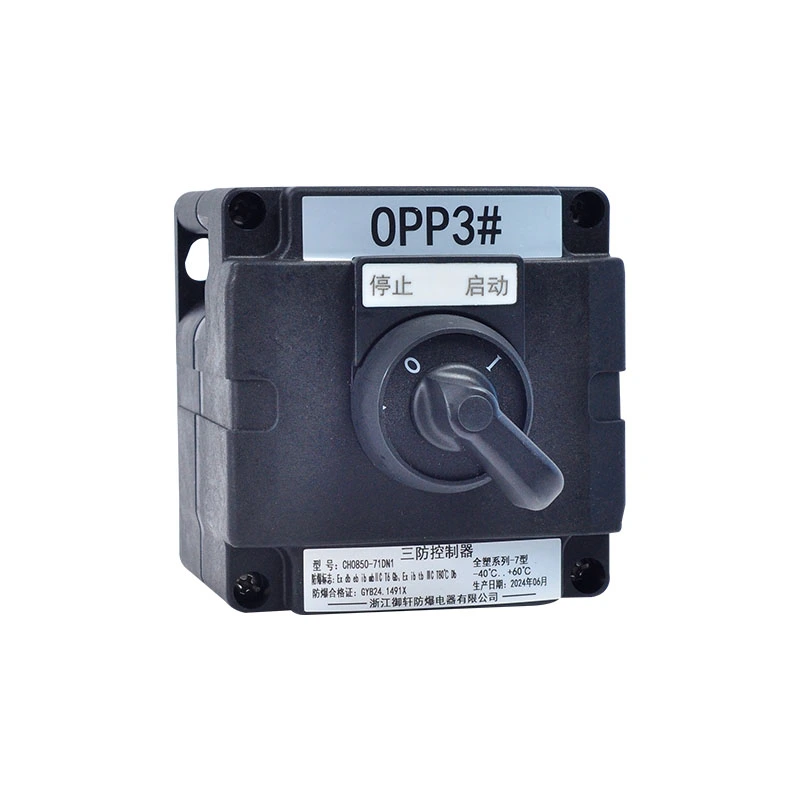
Phase 1: Immediate Safety Isolation & Visual Triage
Before any meter touches the unit, lock-out/tag-out (LOTO) must be verified. The Full Plastic Explosion-proof Controller housing must be cooled to ambient temperature. Inspectors should wear anti-static PPE to avoid surface discharge risks.
| Check Point | Acceptance Criteria | Action if Failed |
|---|---|---|
| External housing cracks or crazing | No visible stress lines, burns, or melting | Replace entire enclosure – Yuxuan offers OEM-matched shells |
| Flamepath/threaded joints | Clean, no deformation, gap ≤ 0.15 mm | Re-machine or replace; re-certification required |
| Cable gland tightness | Torque within 2.5–3.5 N·m range | Re-torque; replace damaged O-rings |
| Ex-e terminal box internal arcing signs | No carbon tracking or pitting | Clean with isopropanol; check creepage distances |
Critical Note: Polyamide or glass-reinforced polyester materials used in Full Plastic Explosion-proof Controllers can lose up to 30% of impact resistance after a high-energy fault. Yuxuan recommends ultrasonic thickness testing on the housing wall if fault current exceeded 10 kA.
Phase 2: Electrical Integrity & Insulation Resistance Testing
After visual clearance, perform a 500V DC megger test between all active phases and earth. For a Full Plastic Explosion-proof Controller, the minimum insulation resistance after fault must be ≥ 2 MΩ (per IEC 60079-0). Record baseline values—compare with factory test reports from Yuxuan. If readings drop below 1 MΩ, internal busbars or PCB traces may have sublimated.
Sequence for contactor and relay checks:
-
Measure coil resistance – deviation > ±10% means replacement.
-
Test auxiliary contacts for welding – use micro-ohm meter.
-
Verify thermal overload reset mechanism – manual trip test.
Phase 3: Seal Integrity & Ingress Protection (IP) Verification
A fault-induced thermal spike can degrade the elastomeric seals that give the Full Plastic Explosion-proof Controller its IP66/67 rating. Perform a 24-hour low-pressure (0.2 bar) air leak test. Apply soapy water to all mating surfaces—persistent bubbles indicate seal failure. Yuxuan seal kits are halogen-free and rated for -40°C to +85°C; always use original spares to preserve the Ex certification.
Phase 4: Functional Operational Test Under Load
With no-load, cycle the Full Plastic Explosion-proof Controller 5 times to verify mechanical stroke. Then apply 50% rated load for 1 hour, monitoring terminal temperature via thermocouple. Temperature rise should not exceed 40K above ambient. If any phase shows >5°C imbalance, inspect the busbar connections for micro-fractures—a known issue after fault current surges.
Comprehensive FAQ for Full Plastic Explosion-proof Controller Maintenance
Q1: Can a Full Plastic Explosion-proof Controller be repaired on-site after a major fault, or must it be returned to the manufacturer?
A: Minor repairs—such as replacing terminals, seals, or external cable glands—are permissible on-site, provided the repair agent holds a valid Ex competence certificate and uses only Yuxuan certified spare parts. However, if the housing shows any crack, deep scratch (≥0.5 mm), or distortion of flamepath threads, the unit must be returned to Yuxuan or an authorized service center for housing replacement and re-certification. On-site welding, grinding, or painting on the enclosure is strictly prohibited, as it alters the surface resistivity and can create electrostatic ignition risks.
Q2: How do I verify that the Full Plastic Explosion-proof Controller still meets its explosion-proof classification after replacing internal contactors?
A: Replacing internal electrical components (contactors, overloads, or PCBs) does not automatically void the enclosure’s flameproof certification, but it does require three verifications: (a) The new components must have the same or higher interrupting rating and creepage/clearance distances as the original bill of materials. (b) You must perform a dielectric withstand test at 2× rated voltage + 1000V for 1 minute—no flashover or breakdown allowed. (c) Finally, re-run the internal ignition test (if facility has a test tank) or submit a modification dossier to the notified body. Yuxuan provides free component compatibility checks—simply email the new part numbers to their technical support team.
Q3: What is the maximum allowed interval between the fault occurrence and the first maintenance inspection for a Full Plastic Explosion-proof Controller?
A: The first visual and thermal inspection must occur within 2 hours of the fault trip, but only after the unit has cooled to below 40°C surface temperature. The full electrical and seal integrity tests (Phase 2 and 3 above) must be completed within 48 hours or before re-energizing, whichever is shorter. If the controller is located in a Zone 0 or 20 area, this window shrinks to 24 hours. Yuxuan recommends installing a permanent fault-event recorder on each Full Plastic Explosion-proof Controller to timestamp the event, which helps maintenance planners prioritize inspections without guesswork.
Final Documentation & Trending
Every maintenance action must be logged with: fault current magnitude, trip time, ambient temperature, and all test values. Yuxuan provides digital logbook templates that align with ISO 14224 for asset reliability. Compare your post-fault insulation resistance against the last 3 annual readings—a declining trend indicates gradual moisture ingress even if the fault is cleared.
When to Replace vs. Refurbish
| Condition | Decision | Rationale |
|---|---|---|
| Housing cracked or warped | Replace | Loss of flamepath integrity – non-negotiable |
| Internal busbar pitted but housing intact | Refurbish | Yuxuan offers busbar kits with pre-drilled terminals |
| PCB charred beyond one layer | Replace | Track resistance irreversibly degraded |
| All seals hardened or melted | Refurbish | Full seal kit replacement – cost-effective |
Contact Yuxuan for Expert Support
Post-fault recovery demands precision, not guesswork. A single overlooked micro-crack in your Full Plastic Explosion-proof Controller can lead to a catastrophic loss of containment. Do not rely on generic checklists—partner with engineers who understand the nuances of polymeric Ex-d enclosures.
Contact Yuxuan today for a complimentary post-fault assessment template and priority access to certified spare parts. Visit our support portal or email our 24/7 hazardous-area team directly. Your safety is our specification—let us help you restore your Full Plastic Explosion-proof Controller to full certified performance. Reach out now and secure your next operational cycle.
