

What Maintenance Tasks Help Keep a Compressed Air Dryer Operating Reliably?
2026-10-29
A maintenance technician checks the dew point meter at the outlet of a Compressed Air Dryer and reads minus 5 degrees Celsius. The setpoint is minus 20 degrees Celsius. The dryer has not failed. It is still running, and the outlet pressure is normal. But the dew point has been drifting upward for three weeks, and the pneumatic valves downstream have started to stick in cold weather. This is how a dryer fails: not with a bang, but with a slow loss of performance. The cause is usually a combination of a fouled condenser, a stuck drain trap, or a saturated desiccant. This guide explains the maintenance tasks that keep a compressed air dryer operating reliably and how to schedule them.
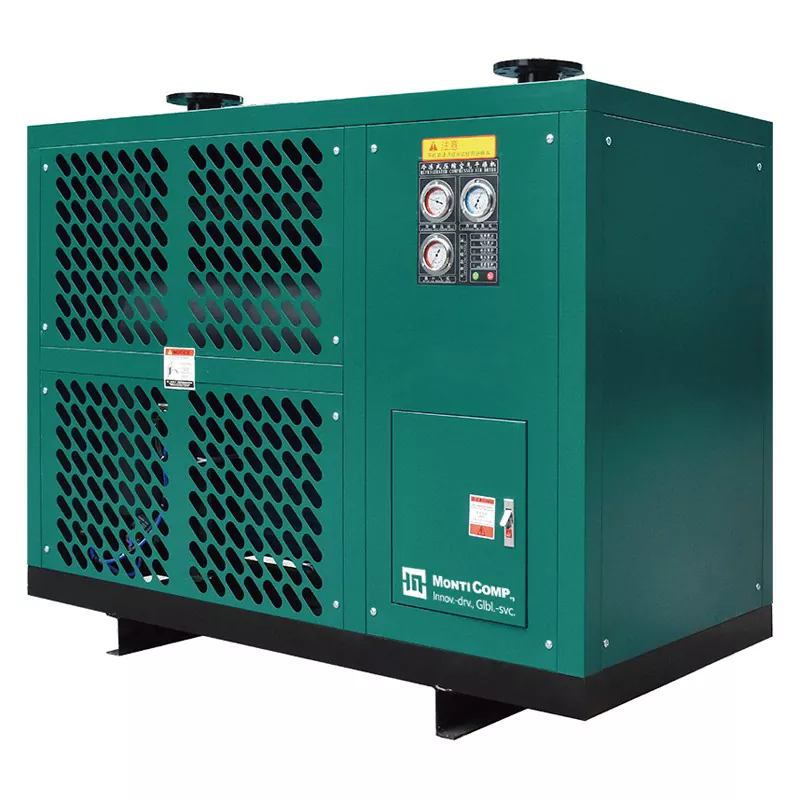
1. Why Does a Compressed Air Dryer Fail Slowly Before It Fails Completely?
A Compressed Air Dryer does not stop working when a component degrades. It continues to run, but the outlet dew point rises. The rise is gradual because the degradation is gradual. A condenser coil accumulates dust, and the condensing temperature rises by a few degrees. A drain trap clogs, and a layer of condensate sits in the separator, re-entering the air stream. A desiccant bed absorbs moisture but the regeneration heater loses capacity, so the bed never fully regenerates. Each of these changes is small, but together they push the dew point above the setpoint. In our factory, we manufacture Compressed Air Dryer units for refrigerated and desiccant applications. Dream (Shanghai) Compression Machinery Co., Ltd. has been manufacturing compressed air dryers for over 12 years.
The slow failure is more dangerous than a sudden failure because it is invisible. The pressure gauge looks normal. The dryer runs. Only the dew point meter reveals the problem, and many plants do not have one installed at the dryer outlet. The first sign is often rust in the downstream piping or a pneumatic cylinder that fails in winter.
2. What Happens Inside a Refrigerated Dryer That Requires Routine Attention?
A refrigerated dryer cools the compressed air to about 3 to 10 degrees Celsius, and the water vapor condenses and is drained away. The main components are the refrigerant compressor, the condenser, the evaporator, and the drain trap. The components that degrade are the condenser coil, the drain trap, and the refrigerant charge. The condenser coil is cooled by air or water. Air-cooled coils collect dust and reduce the heat transfer, which raises the condensing temperature and the dew point. Water-cooled coils collect scale. The drain trap can clog with rust and sludge. The refrigerant charge can leak slowly over years. The table below shows the degradation symptoms and the corresponding maintenance actions.
| Component | Degradation symptom | Maintenance action | Recommended interval |
| Air-cooled condenser | Condensing temperature rises; dew point rises | Clean coil with compressed air or water | Every 500 hours or monthly |
| Water-cooled condenser | Scale buildup; high condensing pressure | Descale with circulation pump | Every 2,000 hours or annually |
| Drain trap | Condensate backs up; water carryover | Disassemble, clean, test operation | Every 500 hours |
| Refrigerant circuit | Low suction pressure; long run time | Leak test; recharge if required | Annually |
| Evaporator | Frost or ice formation | Check defrost cycle; clean fins | Every 1,000 hours |
In our factory, we recommend that every refrigerated dryer installation include a dew point meter at the outlet and a differential pressure gauge across the evaporator. These two instruments show the degradation before the downstream equipment is affected. Dream (Shanghai) Compression Machinery Co., Ltd. supplies the dew point meter and the differential pressure gauge as an optional accessory.
3. How Do Desiccant Dryer Maintenance Needs Differ From Refrigerated Dryer Needs?
A desiccant dryer uses a bed of adsorbent material to remove water vapor from the air. The bed is regenerated by heating it with a purge air stream. The components that degrade are the desiccant, the switching valves, and the regeneration heater. The desiccant degrades by aging, by oil carryover from the compressor, and by mechanical attrition. The switching valves leak, which allows wet air to bypass the bed. The regeneration heater loses capacity, so the bed is not fully dried. The table below compares the maintenance items for the two dryer types.
| Maintenance item | Refrigerated dryer | Desiccant dryer |
| Main filter replacement | Every 1,000 hours | Every 1,000 hours |
| Desiccant replacement | Not applicable | Every 2 – 3 years |
| Drain trap service | Every 500 hours | Every 500 hours |
| Valve inspection | Every 2,000 hours | Every 1,000 hours |
| Heater check | Not applicable | Every 2,000 hours |
| Dew point verification | Monthly | Weekly |
Plant utility engineer's note: The desiccant dryer requires more frequent attention than the refrigerated dryer because the desiccant degrades and the valves cycle continuously. In our factory, we recommend a weekly dew point check for desiccant dryers and a monthly check for refrigerated dryers. A rising dew point in a desiccant dryer usually indicates that the desiccant is saturated or that the switching valve is leaking. Dream (Shanghai) Compression Machinery Co., Ltd. provides a desiccant sampling service to test the remaining adsorption capacity.
4. Why Do Drain Traps and Filters Decide Whether the Dryer Actually Delivers Dry Air?
The drain trap is the most overlooked component in a compressed air system. If the trap fails closed, the condensate accumulates in the separator and is carried downstream. If the trap fails open, compressed air escapes and the system pressure drops. A zero-loss drain trap uses a level sensor and a valve to discharge only the condensate. A timer drain opens at fixed intervals and discharges a mixture of condensate and air. The zero-loss trap saves energy, but it requires a clean strainer and a functioning level sensor. The filters upstream and downstream of the dryer also affect the performance. A clogged pre-filter allows oil and dust to reach the desiccant and coat the evaporator. A clogged after-filter creates a pressure drop that increases the load on the compressor. In our factory, we recommend a pre-filter with a 1 micron rating and an after-filter with a 0.01 micron rating for oil-free air. Dream (Shanghai) Compression Machinery Co., Ltd. supplies the filters and the drain traps as part of the dryer package.
We also recommend that the drain trap be installed with a bypass so that it can be serviced without stopping the dryer. The bypass should be labeled and the valve position should be recorded in the maintenance log.
5. How Should Maintenance Teams Build and Verify a Dryer Maintenance Schedule?
The maintenance schedule should be based on two triggers: the running hours and the measured dew point. The running-hour trigger ensures that the routine tasks, such as coil cleaning and filter replacement, are performed on time. The dew point trigger ensures that the performance degradation is detected even if the running hours are low. The schedule should list each task, the interval, the acceptance criterion, and the person responsible. The verification should include a dew point measurement after each major service and a pressure drop measurement across the filters. In our factory, we provide a maintenance schedule template with each Compressed Air Dryer. The template can be customized for the specific model and the site conditions. Dream (Shanghai) Compression Machinery Co., Ltd. also offers a remote monitoring option that logs the dew point and the drain trap operation.
We recommend that the maintenance team record the dew point, the condensing temperature, the pressure drop, and the drain trap operation in a logbook. The logbook reveals the trend before the dew point exceeds the limit. A dew point that rises by 2 degrees Celsius over a month is a warning sign that should be investigated before it becomes a production issue.
Frequently Asked Questions About Compressed Air Dryer Maintenance
Summary for Plant Utility Engineers and Maintenance Teams
A Compressed Air Dryer fails slowly, and the slow failure is invisible without a dew point measurement. The maintenance tasks that keep the dryer reliable are condenser cleaning, drain trap service, filter replacement, refrigerant charge check, and desiccant replacement. The schedule should be based on both running hours and dew point trends. The drain trap and the filters are the components that most often decide whether the dryer actually delivers dry air. Dream (Shanghai) Compression Machinery Co., Ltd. has been manufacturing Compressed Air Dryer units for over 12 years and provides full maintenance scheduling and monitoring support for our customers.
