

What Makes Threaded Flange Ideal for Instrumentation?
2026-10-26
An instrument engineer is laying out the piping for a pressure transmitter on a chemical reactor. The line is 1/2 inch, the pressure is 40 bar, and the transmitter must be removed for calibration every six months. A welded flange would require cutting and re-welding at every calibration. A threaded flange allows the transmitter to be removed and reinstalled with a wrench. This is why the Threaded Flange is the default choice for instrument connections in small-bore piping. But the choice is not only about convenience. The thread profile, the sealing method, and the material must all be matched to the process conditions. This guide explains what makes the threaded flange ideal for instrumentation and how to specify it correctly.
1. Why Does Instrumentation Piping Demand a Different Flange Approach From Process Piping?
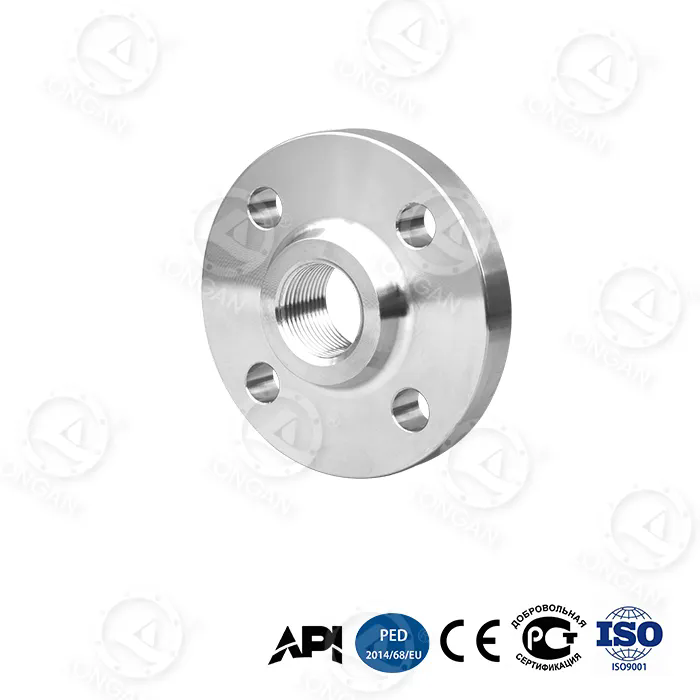
Instrumentation piping is fundamentally different from process piping. The line size is small, typically 1/2 to 2 inches. The pressure rating can be high, up to 250 bar in some applications. The piping is routed in tight spaces inside analyzer houses, instrument cabinets, and skids. Most importantly, the instruments must be removed for calibration, cleaning, or replacement. A welded connection would require cutting the pipe and re-welding, which is time-consuming and introduces the risk of weld defects. A Threaded Flange allows the instrument to be disconnected with a wrench and reconnected without hot work. In our factory, we manufacture Threaded Flange units in sizes from 1/2 to 4 inches and pressure classes from Class 150 to Class 2500. Wenzhou Longan Flange Co., Ltd. has been manufacturing instrument flanges for over 12 years.
The small-bore nature of instrumentation piping also means that the flange must be compact. A standard welded neck flange is bulky and requires a long straight run for welding. A threaded flange is shorter and can be installed in a confined space. The threaded connection also allows the flange to be oriented at any angle before tightening, which simplifies the alignment of the instrument.
2. What Installation Advantages Does a Threaded Flange Offer in Tight Instrument Enclosures?
The installation advantages of a Threaded Flange are most evident in tight enclosures. There are four specific advantages. The first is no hot work. Welding inside an analyzer house or an instrument cabinet is hazardous because of the presence of flammable gases and the risk of damaging nearby instruments. A threaded connection requires only a wrench. The second is no special equipment. Welding requires a certified welder, a welding machine, and post-weld inspection. A threaded connection requires a pipe wrench and a torque wrench. The third is easy alignment. The flange can be rotated to align the bolt holes with the mating flange before tightening. The fourth is easy replacement. If the flange is damaged, it can be replaced without cutting the pipe. The table below compares the installation requirements of threaded, welded neck, and lap joint flanges in instrument service.
| Installation factor | Threaded flange | Welded neck flange | Lap joint flange |
| Hot work required | No | Yes | No |
| Special equipment | Pipe wrench, torque wrench | Welding machine, certified welder | Pipe wrench, torque wrench |
| Installation time (per joint) | 5 – 10 minutes | 45 – 90 minutes | 10 – 15 minutes |
| Alignment adjustment | Rotate before tightening | Fixed after welding | Rotate before tightening |
| Replacement without cutting | Yes | No | Yes |
In our factory, we thread our flanges according to ASME B1.20.1 (NPT) or ISO 7/1 (BSPT). The threads are cut on a CNC lathe and inspected with go/no-go gauges. Longan provides a thread gauge certificate with every batch.
3. How Does the Threaded Connection Maintain Seal Integrity Under Vibration and Thermal Cycling?
The seal integrity of a Threaded Flange depends on the thread profile and the sealing method. There are two common thread profiles: tapered thread (NPT or BSPT) and parallel thread (BSPP). A tapered thread seals by the wedging action of the threads themselves. A sealant or PTFE tape is applied to the male thread to fill the spiral gap. A parallel thread does not seal on the threads. It seals on a gasket or an O-ring at the flange face. The table below shows the sealing method and the recommended application for each thread profile.
| Thread profile | Sealing method | Pressure range | Vibration resistance |
| NPT (tapered) | Thread interference + sealant | Up to 100 bar | Moderate (requires re-tightening) |
| BSPT (tapered) | Thread interference + sealant | Up to 100 bar | Moderate (requires re-tightening) |
| BSPP (parallel) | Gasket or O-ring at flange face | Up to 250 bar | Good (gasket absorbs vibration) |
| NPSM (parallel) | Gasket at flange face | Up to 150 bar | Good |
Instrument engineer's note: For high-vibration applications such as compressor skids, we recommend a parallel thread with a gasket seal rather than a tapered thread with sealant. The gasket absorbs the vibration and maintains the seal without requiring re-tightening. For general instrument service, the tapered thread is acceptable and is more common. In our factory, we offer both thread profiles and can advise on the best choice for the specific application. Wenzhou Longan Flange Co., Ltd. provides a torque specification for each thread size and profile.
4. Why Does Material Selection Matter More for Instrument Flanges Than for Large Process Flanges?
The material of a Threaded Flange is more critical in instrument service than in large process service because the flange is in direct contact with the process medium, and the wall thickness is thinner. A large process flange has a thick wall that can tolerate some corrosion allowance. An instrument flange has a thin wall, and a small amount of corrosion can penetrate through the wall. The material must be selected for the specific medium, temperature, and pressure. The most common materials are stainless steel 304, 316, 316L, and duplex stainless steel. The table below shows the recommended material for common instrument services.
| Service medium | Recommended material | Temperature limit | Typical application |
| Water, steam, air | Stainless steel 304 | 400°C | General instrument air |
| Mild chemicals, seawater | Stainless steel 316 | 450°C | Chemical dosing lines |
| Corrosive chemicals, high chloride | Stainless steel 316L or duplex | 500°C | Analyzer sampling lines |
| High-pressure gas | Duplex or alloy steel | 550°C | Wellhead instrumentation |
In our factory, we verify the material of every Threaded Flange with a spectrometer before machining. The material certificate is traceable to the heat number. Wenzhou Longan Flange Co., Ltd. provides a material certificate with every shipment and can provide a third-party inspection report on request.
5. How Should Engineers Specify and Verify a Threaded Flange for Instrument Service?
The specification of a Threaded Flange for instrument service must include five items. The first is the size and pressure class. The second is the thread standard and profile (NPT, BSPT, BSPP). The third is the material grade. The fourth is the sealing face type (raised face, flat face, or ring joint). The fifth is the marking and traceability requirement. The verification at receipt should include three checks. The first is the thread inspection with a go/no-go gauge. The second is the material certificate review. The third is the dimensional check of the flange face and the bolt circle. In our factory, we perform all three checks before shipment and provide the inspection report with the goods.
We also recommend that the engineer verify the thread engagement after installation. The thread engagement should be at least 1.5 times the nominal diameter for a tapered thread and at least 1.0 times the nominal diameter for a parallel thread. A shorter engagement can lead to leakage under pressure or vibration. Wenzhou Longan Flange Co., Ltd. provides an installation guide that includes the recommended engagement and torque values for each thread size.
Frequently Asked Questions About Threaded Flange for Instrumentation
Summary for Instrument Piping Engineers
The Threaded Flange is ideal for instrumentation because it allows instruments to be removed and reinstalled without hot work, it fits in tight enclosures, and it provides a reliable seal when the thread profile and sealing method are correctly selected. The material must be matched to the process medium, and the thread standard must be specified explicitly to avoid mismatches. The specification should include size, pressure class, thread standard, material, and sealing face. The verification at receipt should include thread inspection, material certificate review, and dimensional check. Wenzhou Longan Flange Co., Ltd. has been manufacturing Threaded Flange units for over 12 years and provides full specification and verification support for instrument piping projects.
