

What Role Do Surface Treatments Play in Enhancing the Durability of Metal Valve Parts
2026-04-23
When discussing the longevity and reliability of industrial flow control systems, Metal Valve Parts are often the most stressed components. At Sanlo, we have observed that untreated surfaces are the primary reason for premature failure in valves. Surface treatments are not merely aesthetic coatings; they are engineered solutions that directly combat wear, corrosion, and fatigue. This blog explores how these treatments transform standard alloys into high-performance Metal Valve Parts capable of withstanding extreme conditions.
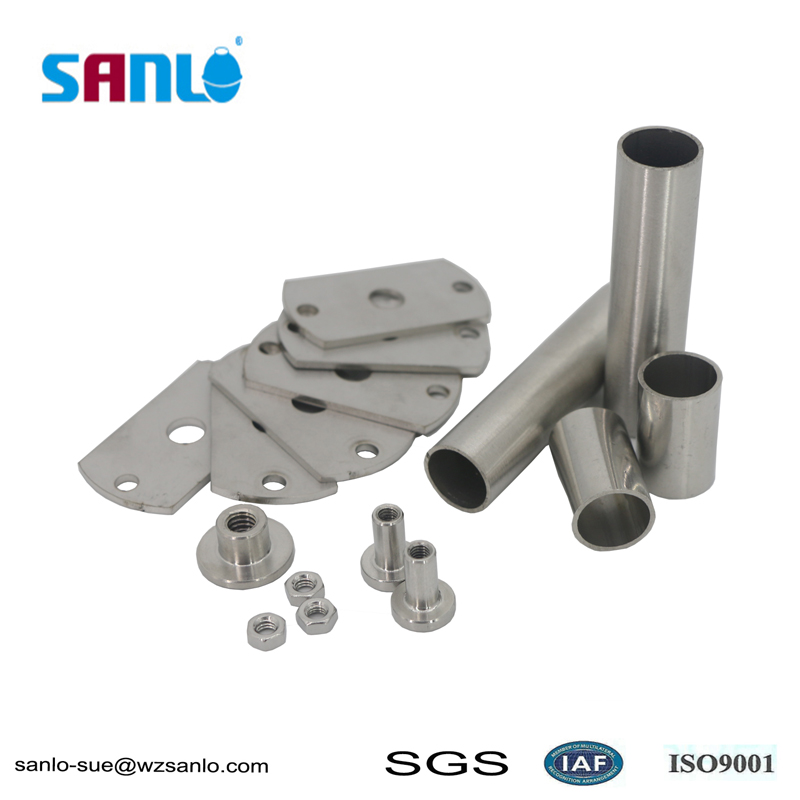
The Core Role of Surface Treatments
Surface treatments modify the outer layer of Metal Valve Parts to create properties that the base metal does not naturally possess. These processes can increase hardness, reduce friction, or add a protective barrier against aggressive media. The table below outlines the primary benefits.
| Treatment Type | Primary Function | Durability Enhancement |
|---|---|---|
| Hard Chrome Plating | Increases surface hardness (up to 70 HRC) | Reduces abrasive wear by over 60% |
| Electroless Nickel | Uniform corrosion barrier | Excellent for H₂S and saline environments |
| Nitriding | Diffuses nitrogen into the metal | Improves fatigue strength by 40-50% |
| PTFE or Epoxy Coating | Lowers friction coefficient | Prevents galling and chemical attack |
Without these layers, Metal Valve Parts would suffer from micro-welding, pitting, and stress corrosion cracking, leading to unplanned downtime. Sanlo integrates advanced treatments like thermal spray and deep nitriding to ensure our components meet the demands of oil, gas, and chemical processing.
How Treatments Prevent Specific Failure Modes
The industrial environment attacks Metal Valve Parts in three distinct ways: mechanical wear, chemical corrosion, and thermal degradation. Surface treatments address each pathway systematically. For instance, a hard anodized layer on a valve stem prevents adhesive wear during high-cycle operation, while a zinc-nickel alloy coating on a valve body stops galvanic corrosion in marine applications. Sanlo leverages these technologies to extend service intervals by 200-300% compared to untreated components.
Frequently Asked Questions (FAQ) About Metal Valve Parts
Question 1: Can surface treatments repair already worn Metal Valve Parts?
Answer: Yes, but with strict limitations. Worn Metal Valve Parts can be restored using processes like thermal spray (HVOF) or brush plating, which rebuild the original dimensions. However, the success depends on the depth of the damage. For components with cracks or deep pitting exceeding 0.5mm, replacement is safer. Sanlo typically recommends reconditioning only for high-cost parts like large gate valve wedges or ball valve seats. Properly re-treated parts can achieve 90% of the life of new components, provided the base metal is not compromised.
Question 2: How do I select the right surface treatment for Metal Valve Parts in sour service (wet H₂S)?
Answer: For sour service, the priority is preventing sulfide stress cracking (SSC). Standard hard chrome is often avoided because micro-cracks can trap hydrogen. Instead, Sanlo recommends electroless nickel plating with a phosphorus content above 11% or a specialized PVD (Physical Vapor Deposition) coating like TiN. These treatments create a non-porous barrier that blocks hydrogen intrusion. Always verify that the treatment meets NACE MR0175/ISO 15156 standards. Without this, Metal Valve Parts can fail catastrophically within weeks in H₂S-rich environments.
Question 3: Do surface treatments eliminate the need for lubrication on Metal Valve Parts?
Answer: Not entirely, but they significantly reduce lubrication dependence. Treatments like PTFE impregnation or DLC (Diamond-Like Carbon) create self-lubricating surfaces. In low-cycle applications (e.g., manual isolation valves), Metal Valve Parts with these treatments can operate dry without galling. However, for high-speed or continuous cycling (e.g., control valves), a minimal lubricant layer still prevents adhesive wear. Sanlo designs our treated Metal Valve Parts to work with dry-running capabilities for clean gases while offering grease pockets for wet services.
Conclusion
Surface treatments are the silent guardians of Metal Valve Parts. They transform vulnerable metal into a resilient barrier against pressure, heat, and chemicals. By selecting the correct treatment—whether nitriding for fatigue resistance or electroless nickel for corrosion—operators can achieve predictable, long-term performance. Sanlo continues to lead in this field by pairing advanced metallurgy with certified surface engineering.
Contact us today to discuss your specific application. Let Sanlo engineer the right surface solution for your Metal Valve Parts to maximize uptime and reduce total ownership costs.
