

What Water Quality Requirements Should Electronics Manufacturers Consider When Selecting a Pure Water System?
2026-11-17
Why Is Water Purity So Important in Electronics Manufacturing?
Water used in electronics manufacturing must meet the requirements of the process it serves. During wafer cleaning, component rinsing, printed circuit board production and precision surface treatment, even small amounts of dissolved ions, organic compounds or suspended particles can leave residues on sensitive surfaces. These contaminants may contribute to defects, electrical leakage, corrosion or reduced product reliability. Selecting a Pure Water System therefore requires more than checking its nominal production capacity or salt rejection rate. Manufacturers need to define measurable water-quality targets at the actual point of use.
The required purity level varies with the manufacturing process. General equipment washing may tolerate a different water quality from final wafer rinsing or advanced semiconductor fabrication. High-purity applications commonly require close control of resistivity, total organic carbon, particles, silica, trace metals, dissolved gases and microbial contamination. A suitable treatment design should identify these risks, select the necessary purification stages and maintain water quality throughout storage and distribution.
ASTM D5127 provides guidance for ultrapure water used in electronics and semiconductor manufacturing. It describes different water-quality classifications and relates recommended limits to manufacturing requirements. Importantly, the guidance addresses water at the point of distribution, not simply the water leaving the RO equipment. This distinction matters because storage tanks, pipework, valves and distribution loops can introduce contamination after the initial purification stage.
Which Water Quality Parameters Should Electronics Manufacturers Evaluate?
Water specifications should be developed around the sensitivity of the product and the process. A single conductivity or TDS reading cannot describe every contaminant that may affect an electronic component. For demanding applications, manufacturers need a broader analytical profile and a monitoring plan that can identify changes before they affect production.
Resistivity and conductivity are commonly used indicators of ionic purity. Resistivity increases as the concentration of dissolved ions decreases. High-purity water for advanced semiconductor applications may target resistivity close to 18.2 megohm-centimetres at 25 degrees Celsius. However, a high resistivity reading does not prove that the water is free from organic compounds, particles, silica or microorganisms. It should be interpreted alongside other analytical results.
Total organic carbon measures the amount of carbon present in organic compounds. Organic residues can affect surface cleanliness and may interfere with sensitive manufacturing processes. For high-purity semiconductor water, TOC targets are commonly specified in the low parts-per-billion range. The required limit should be established according to the process and the applicable water-quality classification.
Particles and colloidal matter are important because very small contaminants can remain on wafer surfaces, precision components or circuit substrates. Particle limits should specify both the particle size range and the maximum count per unit volume. A general turbidity measurement is useful for raw-water and pretreatment control, but it does not replace fine particle counting in a high-purity distribution system.
Silica, dissolved metals and ionic contaminants also require attention. Silica can contribute to deposits that are difficult to remove, while trace metals such as sodium, calcium, iron, copper and aluminium may cause contamination or affect downstream processes. Chloride, sulfate, nitrate and other anions should be controlled according to the sensitivity of the application. In demanding processes, these substances may need to be measured at sub-parts-per-billion concentrations using suitable analytical methods.
Microorganisms and dissolved gases should not be overlooked. Bacterial growth can contribute to biofilm formation in tanks and distribution loops. Dissolved oxygen and carbon dioxide may also influence water chemistry and certain surface processes. The design may therefore require sanitary construction, controlled circulation, appropriate disinfection and additional degassing or polishing stages.
| Water quality parameter | What it indicates | Why it matters to electronics manufacturing | Typical monitoring approach |
| Resistivity | Concentration of dissolved ionic substances | Helps assess ionic purity for sensitive cleaning and rinsing processes | Online resistivity monitoring with temperature compensation |
| TOC | Organic carbon contamination | Helps control organic residues on sensitive surfaces | Online TOC analyser or laboratory testing |
| Particles | Suspended solid contamination by size range | Reduces the risk of particle deposition and surface defects | Online particle counter and validated sampling |
| Silica | Dissolved and total silica concentration | Helps prevent deposits and contamination in precision processes | Laboratory analysis or suitable trace-level analyser |
| Trace metals and anions | Specific ionic and metallic impurities | Supports control of residues that may affect electrical or surface performance | Ion chromatography and ICP-MS where appropriate |
| Bacteria | Microbial contamination | Helps control biofilm and microbial contamination in the water loop | Microbiological sampling and trend analysis |
| Dissolved oxygen and carbon dioxide | Dissolved gas concentration | May influence oxidation, water chemistry and process consistency | Application-specific online or laboratory measurement |
For high-end semiconductor applications, ASTM D5127 includes classifications with resistivity recommendations reaching 18.2 megohm-centimetres at 25 degrees Celsius, together with low TOC, silica, particle and ionic impurity levels. These figures are reference points rather than universal specifications for every electronics factory. The selected classification should reflect the process technology, device sensitivity and customer requirements.
How Should a Pure Water System Be Configured for Electronics Production?
A treatment train should be selected according to the quality of the incoming water and the required quality at the production line. Reverse osmosis is widely used as a major desalination stage because it reduces dissolved salts and many other contaminants. However, RO permeate alone may not meet the stringent requirements of advanced semiconductor manufacturing. Additional polishing processes are often necessary to achieve and maintain ultrapure water quality.
A typical process arrangement may include the following stages, although the final configuration should be confirmed through raw-water analysis and process requirements.
- Raw-water pretreatment: Multimedia or sand filtration reduces suspended solids and protects downstream equipment.
- Activated carbon filtration: Helps remove free chlorine and certain organic substances that may damage RO membranes.
- Water softening or scale control: Reduces the risk of hardness-related scaling on membrane surfaces.
- Precision cartridge filtration: Captures remaining fine particles before the RO stage.
- Reverse osmosis: Reduces dissolved salts and a broad range of contaminants.
- Electrodeionisation or mixed-bed polishing: Further reduces residual ions where the required product-water quality demands it.
- UV treatment and ultrafiltration: Can be incorporated to control organic or microbial contamination and fine particles, depending on the application.
- Ultrapure water distribution: Uses appropriately selected piping, storage and circulation arrangements to protect water quality at the point of use.
Not every electronics facility needs every stage. A printed circuit board manufacturer may have different requirements from a semiconductor wafer fabrication plant. The process design should avoid both under-treatment and unnecessary complexity. Our engineering assessment should begin with the intended use of the water, the raw-water report, the required production volume and the customer's acceptance criteria.
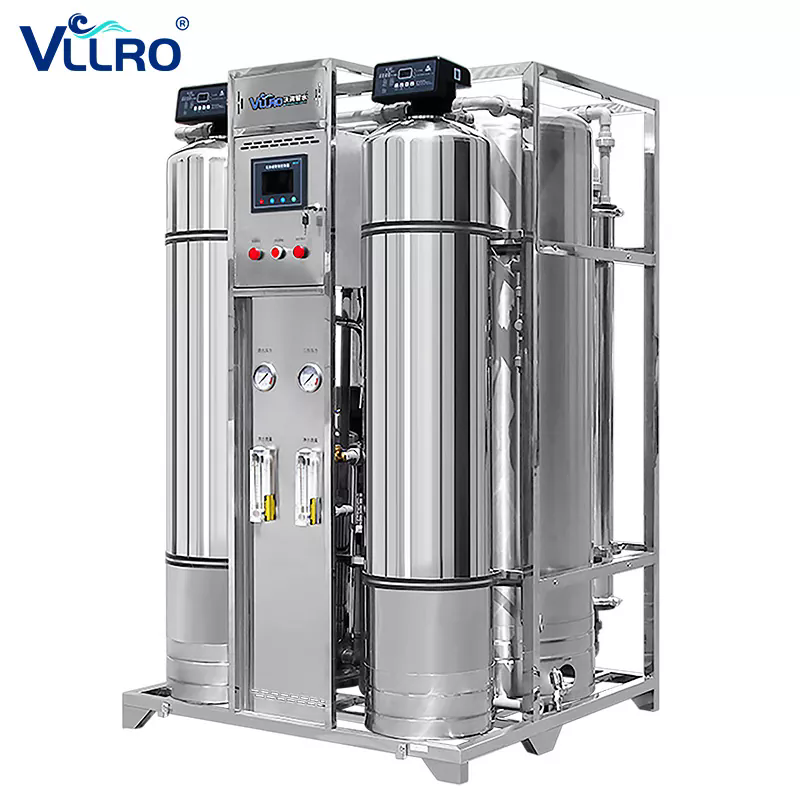
Jianyun Zhishui (Qingdao) Industrial Technology Co., Ltd. publishes industrial RO configurations using staged pretreatment followed by membrane desalination. One listed configuration, VLLRO-RO-3.0, has a nominal production capacity of 3.0 tons per hour and a stated desalination rate of 99.40 percent. Its process includes sand filtration, activated carbon filtration, optional scale inhibitor dosing, precision filtration and RO membranes. This provides a practical foundation for industrial desalination, but additional polishing should be evaluated when the end user requires semiconductor-grade ultrapure water.
| Published equipment parameter | VLLRO-RO-3.0 specification | Engineering consideration |
| Model | VLLRO-RO-3.0 | Reference industrial RO configuration |
| Nominal water production | 3.0 tons per hour | Should be matched to actual hourly demand and operating hours |
| Desalination rate | 99.40 percent | Published performance figure; actual results depend on feed-water and operating conditions |
| Pretreatment sequence | Sand, carbon, optional scale inhibitor and precision filter | Selected to protect the RO membrane from common feed-water contaminants |
| RO membrane | HuiTong 8040 membranes, three units | Membrane configuration for the listed model |
| High-pressure pump | SHIMGE | Provides operating pressure for the RO stage |
| Inlet pressure | 0.2 to 0.4 MPa | Feed-water supply should remain within the specified operating range |
| RO operating pressure | 0.8 to 1.2 MPa | Operating conditions should be confirmed against site water quality |
| Voltage options | 110V, 220V or 380V selectable | Must match the site's electrical infrastructure |
| Raw-water TDS | Below 1500 ppm | Feed-water limit stated for the listed configuration |
| Raw-water turbidity | Below 5 FTU | Indicates the stated incoming water condition |
| Raw-water iron | Below 0.3 mg/L | Important for assessing pretreatment and fouling risks |
These are published parameters for a particular RO model, not guaranteed ultrapure water specifications at the production point. The stated desalination rate does not independently establish final resistivity, TOC, particle count, silica or trace-metal levels. If the manufacturing process requires 18.2 megohm-centimetre water, the project may need additional deionisation and polishing equipment, along with a controlled distribution loop and point-of-use monitoring.
Our product selection should also account for the plant's required flow rate, available installation space, electrical supply, feed-water temperature and maintenance arrangements. Jianyun Zhishui (Qingdao) Industrial Technology Co., Ltd. offers industrial RO equipment in different capacity configurations. The published model data can support preliminary evaluation, while the final design should specify any additional treatment stages required to achieve the customer's water-quality targets.
Why Do Storage, Distribution and Monitoring Matter as Much as Treatment?
Water quality can deteriorate after purification if the storage and distribution system is not designed appropriately. A treatment unit may produce water that meets the required specification at its outlet, but contamination can be introduced through unsuitable tank materials, pipework, seals, valves, stagnant sections or poorly maintained filters. For electronics manufacturers, the quality at the point of use is more important than the quality measured only at the treatment skid.
High-purity water distribution systems should be designed to minimise contamination and prevent stagnant water. Depending on the application, engineers may consider high-purity polymer piping or other compatible materials, hygienic tank construction, continuous recirculation and suitable point-of-use filtration. Material selection should take account of extractables, leaching, corrosion resistance, temperature and chemical compatibility. Dead legs and unnecessary connection points should be minimised because they can create areas where water quality is harder to control.
Storage arrangements also need careful evaluation. A larger tank does not automatically improve water quality. Excessive residence time can increase the risk of microbial growth or changes in dissolved gas levels. Tank capacity should be matched to production demand, system recovery rate and the operating strategy. Where required, circulation, UV treatment, filtration or other controls can help maintain water quality during storage and distribution.
Online monitoring provides an early indication of changes in operating conditions. A practical monitoring plan may include:
- Resistivity or conductivity at the RO outlet and selected distribution points.
- Flow and pressure measurements across pretreatment and membrane stages.
- RO feed-water and permeate conductivity trends.
- TOC monitoring where the application requires continuous organic contamination control.
- Particle monitoring at critical points in the ultrapure water loop.
- Scheduled testing for silica, trace metals, anions and microbiological contamination.
- Alarm limits, calibration schedules and documented responses to abnormal results.
Monitoring frequency should reflect the risk and sensitivity of the process. Resistivity can be monitored continuously, while trace metals or specific ionic contaminants may require periodic laboratory analysis using suitable detection limits. Sampling methods also matter. Poor sample handling, contaminated containers or unsuitable tubing can distort results, especially when target concentrations are extremely low. Our quality checks should therefore define sampling locations, analytical methods, instrument calibration and response procedures.
Maintenance is equally important. Pretreatment filters need inspection and replacement based on operating conditions, while RO membranes require performance monitoring and cleaning when indicated by normalised operating data. Deionisation media, UV lamps, final filters and monitoring instruments also have service requirements. Our maintenance plan should record replacement dates, pressure trends, water-quality results and corrective actions so that changes can be investigated before they affect manufacturing output.
VLLRO can be considered for the RO treatment section of an electronics water project. Our technical staff should review the raw-water analysis and the final process-water specification before confirming whether the published RO configuration is sufficient as a pretreatment stage or whether additional polishing and distribution equipment must be incorporated.
How Can Manufacturers Qualify a Supplier and Confirm System Suitability?
Supplier qualification should focus on technical evidence rather than general claims about water purity. Manufacturers should request a process flow diagram, equipment list, rated capacity, feed-water limits, expected permeate quality, operating pressure range and relevant component details. Where the project requires ultrapure water, the proposal should clearly identify which equipment achieves each specified quality parameter and where those parameters will be measured.
Before approving a system, the project team should confirm the following information:
- Raw-water analysis covering TDS, hardness, turbidity, iron, silica and other relevant contaminants.
- Required product-water quality at each application and point of use.
- Expected hourly and daily water consumption, including peak demand.
- Complete treatment sequence, including pretreatment and any polishing stages.
- Equipment capacity under the specified feed-water conditions.
- Monitoring instruments, sampling locations and quality acceptance criteria.
- Maintenance intervals, consumables, membrane replacement and technical support arrangements.
- Commissioning procedures and documented water-quality verification.
Our project team should also review the distinction between design values and verified operating results. A quoted membrane rejection rate is not the same as a guaranteed point-of-use resistivity value. Similarly, a nominal flow rate does not establish that the system will maintain the required water quality at every production outlet. Performance acceptance criteria should be written into the technical agreement and verified during commissioning under agreed operating conditions.
In summary, electronics manufacturers should evaluate ionic purity, TOC, particles, silica, trace metals, microorganisms and dissolved gases according to the sensitivity of their processes. A well-designed RO treatment stage can provide effective desalination, but advanced semiconductor applications may require additional deionisation, UV treatment, ultrafiltration and a carefully controlled distribution loop. The right solution is the one that consistently meets the required water quality at the point of use, not simply the one with the highest advertised desalination rate.
Contact Jianyun Zhishui (Qingdao) Industrial Technology Co., Ltd. with your raw-water analysis, required water quality, production capacity and application details. Our engineers can review the published RO equipment options and discuss the treatment configuration needed for your manufacturing process, including any additional polishing stages required to meet your final water-quality specification.
Frequently Asked Questions
What resistivity should pure water have for semiconductor manufacturing?
High-purity semiconductor applications commonly target resistivity close to 18.2 megohm-centimetres at 25 degrees Celsius. The exact requirement depends on the manufacturing process and applicable water-quality classification. Resistivity should be monitored alongside TOC, particles, silica, trace metals and other contaminants because it only indicates ionic purity and does not establish overall ultrapure water quality.
Can a standard reverse osmosis system produce semiconductor-grade ultrapure water on its own?
Generally, a standard RO system is used as a primary desalination stage rather than the complete ultrapure water treatment solution for advanced semiconductor manufacturing. RO reduces dissolved salts and many contaminants, but further treatment such as electrodeionisation, mixed-bed polishing, UV treatment, ultrafiltration and a controlled distribution loop may be needed to meet stringent resistivity, TOC, particle and microbial limits. The required configuration must be confirmed through water analysis and process specifications.
Why should electronics manufacturers test water quality at the point of use?
Water can pick up particles, ions, organic compounds or microorganisms from storage tanks, pipework, valves and distribution equipment after leaving the treatment unit. Testing only at the RO outlet may therefore fail to identify contamination introduced downstream. Point-of-use sampling verifies the quality actually reaching the manufacturing process and helps confirm that the complete treatment, storage and distribution system is performing as intended.
