

What Weight Capacity Should You Look for in a Nylon Wheel Cable Ground Roller
2026-09-02
Selecting the right cable pulling equipment is rarely about the cable alone. The unsung hero of any smooth installation is the ground roller, and when it comes to durability and surface protection, the Nylon Wheel Cable Ground Roller has become the industry standard. At Lingkai, we have spent years engineering rollers that balance load tolerance with field mobility, yet the single most common question we hear from project managers and foremen is deceptively simple: how much weight should this roller actually carry? The answer is not a fixed number—it depends on cable type, pull length, terrain, and safety margins—but getting it wrong can bend frames, crack wheels, or drag your entire job to a halt.
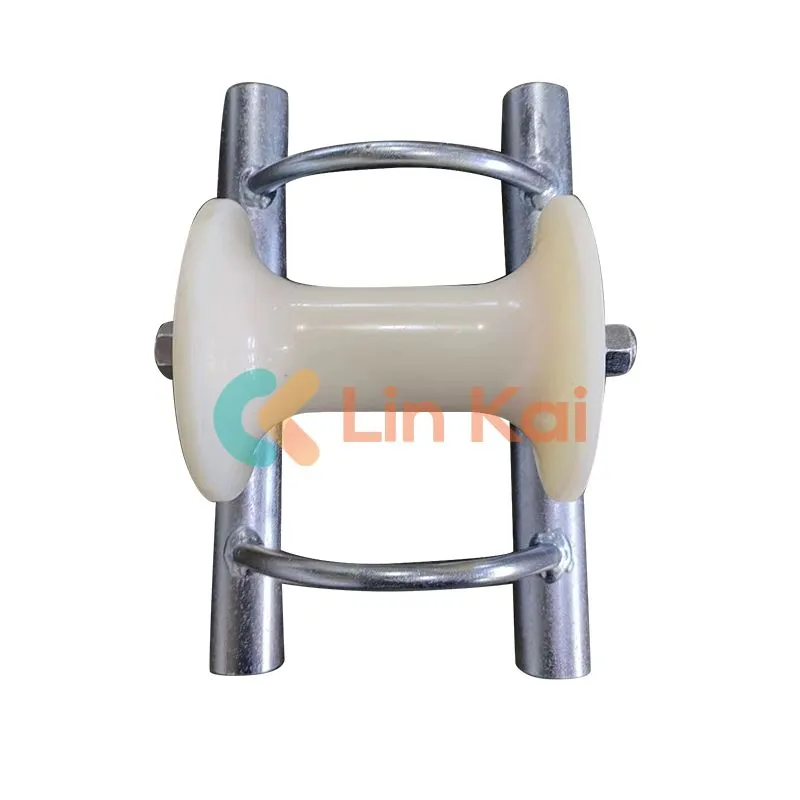
Understanding Weight Capacity in Context
Weight capacity for a Nylon Wheel Cable Ground Roller is never just about the vertical load of the cable resting on the roller. In practice, the roller must endure dynamic tension, side-pull forces during angle changes, and impact loads when cables are dropped onto the wheel. A roller rated for 500 kg (1,100 lbs) of static vertical load may fail under 300 kg of pulling tension if the cable is dragged across at high speed or over uneven ground.
Lingkai classifies capacity into three real-world tiers based on field data from over 200 installation sites:
| Application Tier | Typical Cable Type | Recommended Vertical Load (kg) | Dynamic Tension Tolerance (kg) |
|---|---|---|---|
| Light-duty | CAT6 / Fiber / Coax | 150 – 250 | 100 – 180 |
| Medium-duty | 35kV – 110kV power | 350 – 600 | 250 – 450 |
| Heavy-duty | 220kV+ / Submarine | 700 – 1,200 | 500 – 900 |
Table 1: Load recommendations based on cable class and pulling conditions.
The Three Critical Factors That Dictate Capacity
1. Wheel Material and Bearing Design
Not all nylon is created equal. A premium Nylon Wheel Cable Ground Roller from Lingkai uses cast nylon 6 with glass-fiber reinforcement, which increases compressive strength by nearly 40% compared to standard injection-molded nylon. The hub bearings—sealed, pre-lubricated taper rollers—determine how much side-thrust the wheel can absorb. For capacities above 800 kg, we recommend dual-bearing hubs; single-bushing designs are suitable only for light-duty pulls.
2. Ground Surface and Roller Contact Area
A roller that performs flawlessly on compacted gravel may sink or skid on soft mud or sand. The effective weight capacity decreases by 25–30% on loose surfaces because the wheel’s contact patch widens, increasing rolling resistance and stress on the axle. Lingkai offers wide-profile wheels (120 mm tread width) specifically for soft-terrain jobs, which maintain rated capacity even at 15° inclination.
3. Pulling Angle and Cable Bend Radius
When a cable enters the roller at an angle greater than 10° from the centerline, side-loading on the wheel flange increases exponentially. For every 5° of offset, reduce your rated vertical load by 15%. This is why Lingkai engineers include swivel-eye mounting brackets on all heavy-duty models—they allow the roller to self-align, preserving full capacity even in curved trench runs.
How to Match Capacity to Your Job Sheet
A practical rule of thumb: take the heaviest single drum weight of your cable, add 30% for dynamic shock, and then add another 20% for safety margin. For a 400 kg cable drum, that gives you 400 × 1.3 × 1.2 = 624 kg required vertical capacity. This pushes you firmly into the medium-duty tier.
Below is a quick selection matrix from Lingkai’s product line:
| Model | Vertical Load (kg) | Wheel Diameter (mm) | Best Use Case |
|---|---|---|---|
| LK-200 | 200 | 150 | Fiber / indoor pulls |
| LK-500 | 500 | 200 | Distribution power lines |
| LK-900 | 900 | 250 | Transmission & substation |
| LK-1200 | 1,200 | 300 | Offshore / heavy HV |
Common Misconceptions About Capacity
-
“Heavier is always better.” – Oversizing adds unnecessary weight and cost. A Nylon Wheel Cable Ground Roller rated too high for your cable may not deform enough under light loads, reducing friction grip and allowing the cable to slip sideways.
-
“Capacity is only about the wheel.” – Frame steel gauge and weld integrity are equally critical. Lingkai uses 6 mm thick galvanized steel for medium-duty frames and 10 mm for heavy-duty—exceeding most competitor specs by 2 mm.
-
“One roller does it all.” – On long pulls (over 200 meters), you need a train of rollers, each sharing the total load. In that case, individual roller capacity can be reduced proportionally—but never below 60% of the cable’s static weight per roller.
Frequently Asked Questions (FAQ)
Q1: Can I use a Nylon Wheel Cable Ground Roller rated for 500 kg on a cable that weighs 450 kg, if the pull is only 50 meters long?
A1: Yes, but with strict conditions. At 50 meters, dynamic tension is relatively low, so the vertical load is your primary concern. At Lingkai, we still advise a 20% safety buffer, which would require at least 540 kg capacity. However, if your terrain is perfectly flat and you use a slow, controlled winch (under 10 m/min), a 500 kg roller can handle 450 kg safely. We recommend monitoring the axle temperature every 15 minutes—if it exceeds 60°C, reduce speed or add a second roller to share the load.
Q2: How does the weight capacity of a Nylon Wheel Cable Ground Roller change when the roller is used on an incline, say 20 degrees uphill?
A2: Incline significantly increases the effective load because gravity adds a downhill component that the roller must resist through friction and bearing restraint. For a 20° slope, we derate vertical capacity by approximately 35%. That means a Lingkai LK-900, normally rated for 900 kg, should only carry about 585 kg on that incline. To compensate, we recommend using our LK-1200 model on slopes above 15°, or installing a braking roller in series. Always check the roller’s mounting pin—incline pulls introduce shear forces that can bend undersized pins.
Q3: What happens if I exceed the weight capacity of a Nylon Wheel Cable Ground Roller temporarily—for instance, during a tugger start-up spike?
A3: Short-term overloads (under 2 seconds) are tolerable up to 1.5× the rated static capacity, provided the wheel is from a reputable manufacturer like Lingkai. Our nylon compound has an elastic memory that recovers from momentary compression up to 180% of rated load. However, repeated spikes above 120% will cause microscopic fatigue in the bearing raceways and wheel hub. After any overload event, inspect the roller for lateral play (wobble) and check the frame for hairline cracks near the weld joints. If you anticipate frequent spikes, choose one tier higher in our range—for example, select the LK-900 instead of the LK-500—to absorb those transients without compromising long-term service life.
Final Takeaway for Your Next Purchase
Capacity is not a single number—it is a performance envelope that includes terrain, angle, speed, and duration. The safest approach is to map your heaviest cable, longest pull, and worst ground condition, then select a Nylon Wheel Cable Ground Roller that exceeds that combined requirement by at least 25%. Lingkai provides full load charts, incline derating tables, and bearing temperature guides with every unit—because we believe that informed choices prevent costly field failures.
Ready to specify the right roller for your next project? Our engineering team can review your pull plan and recommend the exact Nylon Wheel Cable Ground Roller model with load calculations tailored to your site conditions. Contact Lingkai today via our website or call your regional distributor—we respond to all technical inquiries within 4 business hours, and we offer free load-testing reports for orders above 20 units. Let us keep your cables moving safely, pull after pull.
