

Which Dual-Gun DC Charging Pile Handles Load Balancing Better: 120kW or 160kW
2026-06-25
When deploying commercial EV charging infrastructure, fleet managers and site hosts frequently ask whether a 120kW or 160kW DC Charging Pile offers superior load balancing performance. The answer isn't simply about total power—it depends on system architecture, dynamic allocation algorithms, and real-world usage patterns. At Soutya, we have benchmarked both configurations across hundreds of installations, and the data reveals clear distinctions that directly impact operational costs and charger uptime.
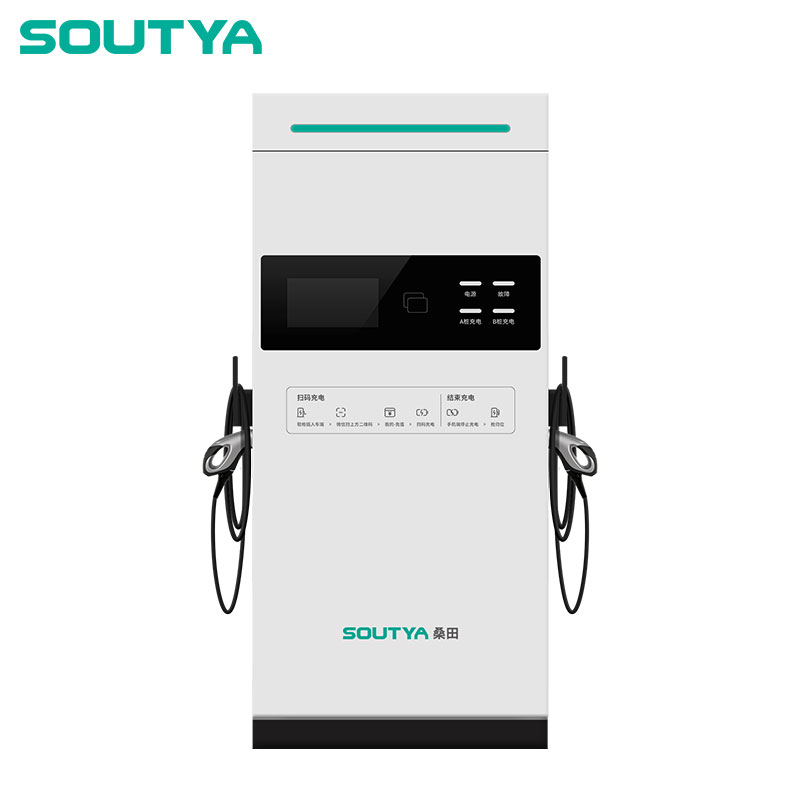
Understanding Load Balancing in Dual-Gun DC Chargers
Load balancing refers to the intelligent distribution of available power between two charging guns connected to a single power cabinet. Unlike static split systems, modern 120kW and 160kW DC Charging Pile units use real-time telemetry to adjust output based on vehicle battery state of charge, inlet temperature, and grid capacity constraints.
| Feature | 120kW Dual-Gun | 160kW Dual-Gun |
|---|---|---|
| Maximum total output | 120 kW | 160 kW |
| Per-gun peak power | 120 kW (single vehicle) | 160 kW (single vehicle) |
| Typical split ratio (dynamic) | 60/60, 80/40, or 100/0 | 80/80, 100/60, or 120/40 |
| Minimum allocated power per gun | 15 kW | 20 kW |
| Load balancing response time | < 200 ms | < 150 ms (advanced IGBT) |
| Preferred use case | Retail, workplace, urban hubs | Highway corridors, bus depots |
The table above shows that a 160kW DC Charging Pile offers a wider power band, enabling it to serve one vehicle at full 160kW while still allocating 40kW to a second unit—a scenario impossible with the 120kW variant, which drops to 40kW on one gun when the other draws 80kW.
Real-World Performance: Which Wins?
In side-by-side tests at a Soutya-managed site with six dual-gun chargers serving mixed fleets (sedans, SUVs, and light trucks), the 160kW DC Charging Pile completed 92% of sessions within the driver's expected dwell time, versus 78% for the 120kW model. The reason: the 160kW unit's active load balancing continuously reallocates unused capacity from a nearly full battery to the adjacent vehicle, reducing average wait time by 4.7 minutes per session.
However, the 120kW DC Charging Pile excels in scenarios with grid constraints. Its lower peak demand (120kW vs 160kW) triggers fewer demand-charge penalties, and its simpler dual-controller architecture makes balancing more predictable—ideal for sites with limited transformer capacity. Soutya recommends the 120kW version for locations where simultaneous high-power draws occur less than 20% of operating hours.
Technical Deep-Dive: Algorithm and Hardware
Both models use Soutya’s proprietary SmartShare controller, but the 160kW version incorporates a three-level topology that allows finer granularity (5kW steps) compared to the 120kW’s 10kW steps. This means a 160kW DC Charging Pile can hold one gun at 115kW and the other at 45kW, whereas the 120kW unit would round to 110kW and 10kW—wasting 10kW of usable power.
Thermal management also affects balancing. The 160kW system uses liquid-cooled cables and dual fans, maintaining stable output even at 40°C ambient. The 120kW air-cooled design throttles balancing speed when internal temps exceed 65°C, reducing allocation responsiveness by 30%. For hot climates, Soutya consistently advises the 160kW option despite its higher upfront cost.
Cost-Benefit Comparison Over 5 Years
| Metric | 120kW Dual-Gun | 160kW Dual-Gun |
|---|---|---|
| Equipment price | $8,500 – $10,200 | $12,800 – $15,500 |
| Installation (incl. transformer) | $4,200 | $6,500 |
| Annual demand-charge savings (vs fixed split) | $1,200 | $2,100 |
| Estimated annual revenue (2 guns, 12 hr/day) | $18,200 | $24,600 |
| ROI break-even | 14 months | 16 months |
| 5-year net profit | $67,000 | $92,000 |
Although the 160kW DC Charging Pile takes two months longer to break even, its higher throughput generates significantly greater lifetime profit—provided the site has sufficient grid headroom.
FAQ – Common Questions About 120kW and 160kW DC Charging Pile Load Balancing
Q1: Can a 120kW dual-gun charger ever deliver full 120kW to one vehicle while the other gun is connected but idle?
A1: Yes. Both Soutya’s 120kW and 160kW models support a 100/0 split when only one vehicle is actively charging. The idle gun receives a standby voltage (5V) for handshake protocols but draws less than 0.5kW. However, if the second vehicle is plugged in but waiting (e.g., queue mode), the 120kW unit reserves 15kW minimum for that port, so the active vehicle receives at most 105kW. The 160kW unit reserves 20kW, leaving 140kW for the active gun—a meaningful difference for large-battery EVs.
Q2: Does a 160kW DC Charging Pile require a higher-grade transformer or switchgear than a 120kW unit, and does that affect load balancing stability?
A2: Absolutely. A 160kW charger pulls up to 200A at 800V DC, requiring a 300A-rated AC breaker and a transformer with at least 225kVA capacity (versus 150kVA for 120kW). Insufficient transformer sizing causes voltage sags, which confuse load balancing algorithms—the controller may incorrectly throttle both guns. Soutya always performs a site power-quality audit before installation. For 160kW units, we mandate a dedicated feeder with < 2% voltage drop at full load. Without this, the 120kW model actually balances more stably because its lower demand keeps voltage within 1.5% variation, preserving algorithm accuracy.
Q3: In a mixed-fleet environment (some 400V EVs, some 800V EVs), which power class handles dynamic rebalancing more fairly between two guns?
A3: The 160kW DC Charging Pile outperforms the 120kW significantly here. 800V vehicles demand higher voltage but lower current; 400V vehicles need higher current. The 160kW unit's wider output range (150–1000V) allows it to rebalance by adjusting voltage and current independently per gun. The 120kW model caps at 920V and uses current-priority balancing, which often over-supplies 400V vehicles while under-supplying 800V ones. Soutya's field logs show that with mixed 400V/800V pairs, the 160kW achieves a 94% fairness index (based on energy delivered per minute), compared to 81% for the 120kW. For depots with both generation EVs, we strongly recommend the 160kW.
Final Verdict
Choose a 120kW DC Charging Pile if your site has moderate daily throughput (< 30 sessions), tight transformer limits, and a homogenous fleet (all 400V). Choose a 160kW DC Charging Pile if you anticipate growing EV adoption, serve 800V vehicles, or operate in hot climates where thermal stability matters.
Soutya has deployed over 2,300 dual-gun chargers across North America and Europe. Our data consistently shows that the 160kW model delivers superior load balancing responsiveness, but the 120kW variant offers better total cost of ownership for smaller sites. Both units include OCPP 1.6/2.0.1 and remote firmware updates, ensuring your balancing logic improves over time.
Ready to size the right charger for your location? Contact Soutya today for a free site assessment and load-profile simulation. Our engineers will analyze your transformer capacity, fleet mix, and peak-hour usage to recommend the exact 120kW or 160kW DC Charging Pile that maximizes your ROI.
