

Which High Temperature Partition Box Medium Filter Delivers Reliable Filtration in Demanding Industrial Environments?
2026-11-18
Article Summary
Maintaining reliable air filtration at elevated temperatures is a major challenge for industrial facilities. Conventional medium-efficiency filters may experience premature material aging, deformation, sealing problems, or declining filtration performance when exposed to demanding thermal conditions. A High Temperature Partition Box Medium Filter is designed to address these challenges by combining heat-resistant filter media, a supporting partition structure, and suitable high-temperature sealing materials.
This guide explores how high-temperature partition box medium filters work, their structural advantages, key material considerations, industrial applications, and the factors buyers should evaluate before purchasing. It also explains how proper installation and maintenance can help control pressure drop, extend filter service life, and protect downstream filtration equipment. Whether you manage a pharmaceutical facility, food processing plant, electronics workshop, or industrial ventilation system, understanding these details can help you make a more reliable filtration decision.
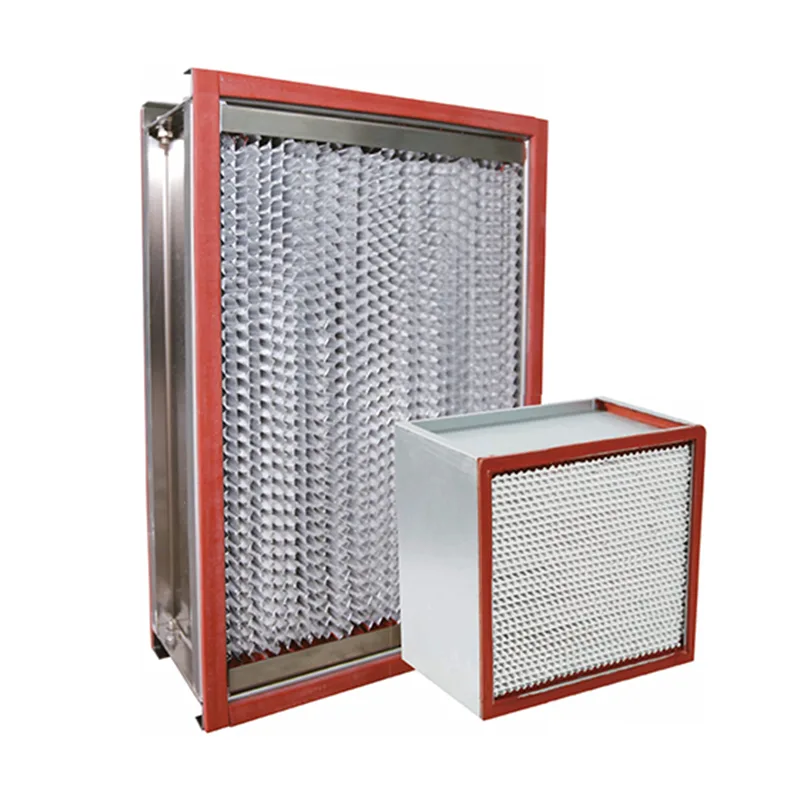
1. What Is a High Temperature Partition Box Medium Filter?
A High Temperature Partition Box Medium Filter is an air filtration component engineered for ventilation and purification systems that operate under elevated-temperature conditions. Its primary function is to capture suspended particles from the airflow before the air reaches more sensitive production areas or downstream filtration equipment.
Unlike an ordinary medium-efficiency filter designed for standard indoor temperatures, a high-temperature version uses materials selected to withstand greater thermal stress. Depending on the product configuration, these materials may include ultra-fine glass fiber filter media, metal frames, aluminum separators, and high-temperature-resistant sealing compounds.
The partition structure supports the filter media and helps maintain a stable pleated configuration. This arrangement provides a practical balance between filtration area, airflow resistance, and structural stability.
Why Is a Special High-Temperature Design Necessary?
Industrial heating, drying, baking, sterilization, and thermal processing operations can expose ventilation systems to temperatures that exceed the limits of conventional filters. When ordinary materials are used outside their rated conditions, several problems may occur:
- Filter media may lose mechanical strength or become deformed.
- Adhesives and sealing materials may deteriorate.
- Air leakage may develop around the filter frame.
- Filtration performance may become inconsistent.
- Frequent replacement may increase maintenance costs.
2. How Does the Filter Work?
The filter operates by forcing contaminated air through a specially arranged filtration medium. As air passes through the fine fiber structure, airborne particles are captured through mechanisms such as interception, inertial impaction, and diffusion.
The cleaned air then moves toward the next stage of the ventilation or purification system. The filter does not simply block all particles at its surface. Instead, its internal fiber structure provides multiple opportunities for particles to contact and remain trapped within the media.
The Filtration Process Step by Step
- Air enters the filter: Contaminated air from a ventilation duct or industrial air handling unit reaches the filter inlet.
- Air passes through the media: The pleated filter material provides an expanded filtration surface within a compact frame.
- Particles are captured: Dust and other suspended contaminants are retained by the fiber structure.
- Cleaned air moves downstream: The filtered airflow continues to subsequent equipment or the target working environment.
- Dust gradually accumulates: As particles collect, resistance increases and the filter eventually requires inspection or replacement.
Why Do Partitions Matter?
Partitions or separators help maintain spacing between pleats. Without adequate support, filter media may collapse, touch neighboring pleats, or become unevenly distributed under airflow pressure.
By maintaining the intended pleat geometry, the partition structure helps preserve usable filtration area and supports more consistent airflow distribution. The exact performance depends on separator spacing, media properties, frame construction, and the design airflow.
3. Key Structural Components and Materials
Every component contributes to the filter's ability to operate reliably under elevated temperatures. Buyers should examine the complete construction rather than focusing only on the advertised temperature resistance of the filter media.
| Component | Primary Function | Important Considerations |
|---|---|---|
| Filter Media | Captures airborne particles. | Fiber type, filtration efficiency, thermal stability, and airflow resistance. |
| Partition Separators | Maintain spacing between pleats. | Material strength, temperature resistance, and structural stability. |
| Metal Frame | Supports the filter assembly. | Dimensional accuracy, corrosion resistance, and mechanical strength. |
| High-Temperature Sealant | Seals joints and reduces bypass leakage. | Temperature rating, adhesion, and compatibility with filter materials. |
| Protective Structure | Helps protect the media during handling and operation. | Airflow obstruction, rigidity, and installation compatibility. |
3.1 Ultra-Fine Glass Fiber Filter Media
Glass fiber media is commonly considered for high-temperature air filtration because suitable grades offer good thermal stability and particle capture characteristics. Its fine fiber structure can provide medium-efficiency filtration while maintaining a relatively compact design.
However, not all glass fiber media have identical properties. Fiber diameter, media density, pleat geometry, and manufacturing quality can affect efficiency, pressure drop, and dust-holding capacity.
3.2 Aluminum Partition Separators
Aluminum separators provide structural support between the filter pleats. They help maintain spacing and reduce the possibility of media deformation under airflow pressure. Their suitability depends on the operating temperature, mechanical loading, and environmental conditions.
3.3 Metal Frames
Metal frames provide dimensional stability and support the complete filtration assembly. Depending on the application, frame options may include galvanized steel, stainless steel, or aluminum alloy.
Stainless steel may be preferred in environments where corrosion resistance and frequent cleaning are important. The correct choice should consider both the temperature and the surrounding atmosphere.
3.4 High-Temperature Sealing Materials
Sealing is critical because air can bypass the filtration media if gaps develop around the frame or component joints. High-temperature-resistant sealants help maintain assembly integrity under the specified operating conditions.
4. Major Benefits for High-Temperature Filtration
Choosing a filter designed for elevated-temperature environments can help solve several operational problems that affect industrial ventilation and purification systems.
Suitable heat-resistant materials help the filter maintain structural integrity within its specified operating temperature range.
Appropriate filter media supports stable particle removal when the equipment operates under its rated conditions.
Partition separators help prevent pleat deformation and maintain the intended filtration area.
Proper frame construction and compatible sealing materials help prevent unfiltered air from passing around the media.
Medium filtration captures a portion of airborne contaminants before they reach higher-efficiency filtration stages.
Appropriate sizing and operating conditions help maintenance teams manage filter replacement based on actual performance.
How Can It Help Control Operating Costs?
The initial purchase price is only one part of the total cost of an industrial filter. Replacement frequency, energy consumption, labor, production interruptions, and downstream equipment protection also affect long-term expenses.
A filter with excessive initial resistance may increase fan energy consumption. A filter with inadequate dust-holding capacity may require frequent replacement. Conversely, a properly selected filter can help balance filtration efficiency, airflow resistance, and service life.
For this reason, buyers should compare the complete operating characteristics instead of choosing a product based on price or efficiency classification alone.
5. Where Are These Filters Commonly Used?
High Temperature Partition Box Medium Filters are relevant to industrial environments where air must be filtered before entering production equipment, processing areas, or subsequent purification stages.
5.1 Pharmaceutical Manufacturing
Pharmaceutical production requires controlled environmental conditions to reduce airborne contamination risks. In suitable ventilation configurations, high-temperature medium filters can serve as an intermediate filtration stage, helping protect downstream high-efficiency filters.
They may be considered for compatible air handling systems associated with thermal processing, drying, or other elevated-temperature operations. Final filter selection must follow the facility's validated temperature and cleanliness requirements.
5.2 Food Processing and Baking Facilities
Food processing operations may involve ovens, drying systems, heated production areas, and ventilation equipment exposed to warm air. Suitable medium filters can help capture airborne dust and other particles from process-related airflow.
For food-related applications, buyers should also evaluate material compatibility, hygiene requirements, cleaning procedures, and the risk of contamination from filter components.
5.3 Electronics and Precision Manufacturing
Dust contamination can affect sensitive components and manufacturing quality. Medium filtration is often used as part of a multi-stage air purification system to reduce the particle load reaching downstream filtration equipment.
In processes involving elevated temperatures, a filter with an appropriate thermal rating can help maintain filtration stability without compromising the overall airflow design.
5.4 Industrial Painting and Coating Workshops
Painting and coating processes require controlled airflow to reduce airborne dust that may settle on wet surfaces. Where ventilation air is heated, high-temperature-compatible filtration components may be needed to maintain air cleanliness and protect the production process.
5.5 Drying and Heat Treatment Equipment
Industrial drying systems and thermal processing equipment may circulate heated air through dedicated ventilation circuits. Filters used in these systems must withstand the actual air temperature and any temperature fluctuations during operation.
5.6 Laboratories and Specialized Ventilation Systems
Some laboratories and technical facilities require carefully controlled air conditions. Medium filters may be incorporated into ventilation systems as a protective filtration stage, provided their efficiency and material specifications match the application.
6. Important Technical Parameters to Evaluate
Technical specifications determine whether a filter is suitable for a particular installation. Buyers should request complete performance information and confirm that the quoted values refer to the intended product configuration.
| Parameter | What It Describes | Why It Matters |
|---|---|---|
| Filtration Efficiency | Ability to capture particles of specified sizes under a defined test method. | Determines whether the filter meets the required air cleanliness level. |
| Operating Temperature | Allowable continuous and, where specified, short-term temperature. | Prevents thermal damage to media, frame, and sealant. |
| Rated Airflow | Air volume passing through the filter per unit of time. | Ensures compatibility with the ventilation system. |
| Initial Pressure Drop | Airflow resistance of a clean filter at a specified airflow. | Influences fan selection and energy consumption. |
| Final Pressure Drop | Defined resistance limit for filter replacement or servicing. | Helps establish a practical maintenance threshold. |
| Dust-Holding Capacity | Amount of test dust retained under specified conditions. | Provides an indication of loading capacity and potential service interval. |
| External Dimensions | Length, width, and depth of the filter. | Ensures proper fit within the filter housing. |
| Frame Material | Material used for the external support structure. | Affects strength, corrosion resistance, and thermal suitability. |
Understanding Pressure Drop
Pressure drop represents the resistance encountered by air as it passes through a filter. It generally increases as dust accumulates in the media.
If pressure drop becomes too high, the ventilation system may experience reduced airflow or require additional fan energy to maintain the target air volume. However, a low pressure drop should not be considered independently of filtration efficiency and dust-holding capacity.
The most suitable product is one that achieves the required particle removal while remaining within the ventilation system's allowable resistance range.
7. How to Select the Right Filter for Your Facility
Choosing the correct high-temperature medium filter starts with understanding the real operating conditions. Product descriptions alone are not enough to establish compatibility with an industrial process.
Step 1: Determine the Actual Temperature
Identify the normal operating temperature, maximum continuous temperature, and any short-term temperature peaks. If the system experiences frequent heating and cooling cycles, provide this information to the manufacturer as well.
Ask for confirmation of the complete assembly's allowable temperature, including filter media, frame, partitions, and sealant.
Step 2: Define the Required Filtration Efficiency
Determine the particle size and cleanliness level that the filtration system needs to address. The filter's classification should be confirmed according to a clearly identified testing standard.
Do not assume that two filters with similar efficiency labels will perform identically if they were tested using different methods.
Step 3: Confirm the Required Airflow
Provide the actual design airflow and operating conditions. The manufacturer can then evaluate whether the selected filter area and construction can support the required air volume without excessive resistance.
Step 4: Check Installation Dimensions
Measure the existing housing or filter mounting space accurately. Confirm the length, width, depth, sealing arrangement, and installation direction.
Step 5: Evaluate Environmental Conditions
Temperature is not the only factor affecting filter durability. Humidity, chemical vapors, corrosive gases, vibration, and airborne oil can also influence material selection and service life.
Step 6: Consider Maintenance Requirements
Determine whether the facility has a fixed maintenance schedule, pressure monitoring system, or specific replacement procedure. A suitable filter should be compatible with the site's maintenance resources and operational needs.
8. Installation and Maintenance Best Practices
Correct installation is essential for achieving the expected filtration performance. Even a high-quality filter may allow contamination to pass downstream if it is installed incorrectly or if the surrounding housing has gaps.
Before Installation
- Confirm the model and dimensions against the equipment specification.
- Check that the filter is suitable for the actual operating temperature.
- Inspect the frame, media, partitions, and sealing surfaces for visible damage.
- Clean the filter housing before inserting the new filter.
- Check the airflow direction and installation orientation.
- Ensure the housing provides a suitable sealing interface.
During Operation
- Monitor pressure drop across the filter.
- Record airflow and operating temperature.
- Check for unusual vibration or abnormal airflow noise.
- Inspect the housing for possible air bypass.
- Review filter condition after process changes or abnormal operating events.
When Should the Filter Be Replaced?
Filter replacement should be based on the manufacturer's recommendations and actual operating conditions. Common warning signs include:
- Pressure drop reaching the specified final resistance limit.
- Visible damage, deformation, or separation of filter components.
- Air leakage around the frame or sealing area.
- Failure to maintain the required airflow.
- Evidence of thermal damage or deterioration.
Cleaning should not be attempted unless the product is specifically designed and approved for cleaning. Many fine-fiber filter media can be damaged by washing, compressed air, or aggressive mechanical handling.
9. Common Filtration Problems and Solutions
Identifying the cause of poor filtration performance can prevent unnecessary replacement and reduce production downtime.
| Common Problem | Possible Cause | Recommended Action |
|---|---|---|
| Rapid Pressure Increase | High dust loading, insufficient filter area, or excessive airflow. | Check upstream dust levels, airflow, and filter sizing. |
| Air Bypass Leakage | Incorrect installation, damaged seals, or dimensional mismatch. | Inspect the housing and sealing interface. |
| Media Deformation | Excessive airflow pressure, insufficient support, or thermal damage. | Verify operating limits and inspect the partition structure. |
| Short Service Life | High dust concentration, unsuitable media, or unexpected temperature peaks. | Review process conditions and select a compatible configuration. |
| Inconsistent Filtration | Damaged media, poor sealing, or uneven airflow distribution. | Inspect the filter assembly and air handling system. |
| Sealant Deterioration | Operating temperature exceeds the material rating or chemical incompatibility. | Confirm sealant specifications with the manufacturer. |
One common purchasing mistake is to focus only on filtration efficiency while overlooking the operating temperature and airflow. For example, a filter with an appropriate efficiency rating may still fail prematurely if its adhesive or sealing material is unsuitable for the process.
A complete technical review is therefore essential before replacing an existing filter with a different model.
10. Medium Filters and HEPA Filters: Understanding Their Roles
Medium filters and HEPA filters serve different positions in a multi-stage air purification system. Understanding their roles helps facility operators avoid incorrect product selection.
Medium Filtration
Medium filters capture a significant portion of airborne particles before the air reaches higher-efficiency filtration stages. They help reduce the particle loading on downstream filters and can contribute to more manageable maintenance requirements.
HEPA Filtration
HEPA filters are designed for higher levels of particle removal under their specified testing standards. They are used in applications where stringent airborne particle control is necessary.
However, a medium filter should not be treated as a direct substitute for a HEPA filter when the application requires HEPA-level performance.
| Comparison | Medium Filter | HEPA Filter |
|---|---|---|
| Primary Role | Intermediate particle filtration. | High-efficiency final filtration. |
| System Position | Often installed upstream of HEPA filters. | Usually installed at a later filtration stage. |
| Typical Purpose | Reduce particle loading on downstream equipment. | Achieve stringent particle removal requirements. |
| Selection Priority | Efficiency, airflow, pressure drop, and dust capacity. | Specified HEPA classification, airflow, and leakage integrity. |
In systems exposed to elevated temperatures, both stages must be selected according to their own temperature limitations. A high-temperature medium filter does not automatically make a downstream HEPA filter suitable for the same operating environment.
11. What Should Buyers Ask a Manufacturer?
Working with a manufacturer that understands industrial filtration can help buyers avoid specification mismatches and unnecessary operating expenses.
Before placing an order, purchasing teams and engineering departments should confirm the following details:
- What is the maximum continuous operating temperature of the complete filter?
- What filter media and partition materials are used?
- Which frame and sealing material options are available?
- What filtration efficiency classification and test standard apply?
- What are the rated airflow and initial pressure drop?
- Is the filter available in the required dimensions?
- Can non-standard sizes or configurations be manufactured?
- What is the recommended final pressure drop for replacement?
- Are technical drawings and product specifications available?
- Can the manufacturer provide guidance on installation and maintenance?
Why Manufacturer Support Matters
Industrial filtration requirements can vary significantly between facilities. A pharmaceutical drying line, a food processing oven, and an electronics production workshop may all require different combinations of filtration efficiency, temperature resistance, and airflow capacity.
A capable manufacturer should be able to review the application details and recommend a product configuration that matches the actual operating conditions.
Jiangsu Grandfort Purification Equipment Co., Ltd. provides air filtration products for industrial and purification applications, including medium filters and specialized high-temperature filter solutions. When evaluating a High Temperature Partition Box Medium Filter, buyers can discuss the intended application, required dimensions, airflow, temperature conditions, and material preferences to determine a suitable configuration.
12. Frequently Asked Questions
Q1. What is a High Temperature Partition Box Medium Filter used for?
It is used to capture airborne particles in ventilation and air purification systems operating under elevated-temperature conditions. Typical applications include industrial drying, food processing, pharmaceutical production, and specialized manufacturing environments.
Q2. What materials are commonly used in this type of filter?
Common construction options include glass fiber filter media, aluminum partition separators, metal frames, and high-temperature-resistant sealing materials. The final combination depends on the operating temperature and application requirements.
Q3. Why are partition separators important?
Partition separators maintain spacing between filter pleats, support the media, and help prevent deformation under airflow pressure. They also help preserve the designed filtration area.
Q4. What is the maximum temperature a high-temperature medium filter can withstand?
The maximum temperature depends on the specific filter model and its complete material construction. Buyers should confirm the continuous operating temperature and any short-term temperature limits with the manufacturer before ordering.
Q5. How does pressure drop affect filter performance?
Pressure drop represents airflow resistance. As dust accumulates, resistance generally increases. Excessive pressure drop can reduce airflow or increase fan energy consumption, so monitoring is important.
Q6. Can a high-temperature medium filter replace a HEPA filter?
No, not when the application requires HEPA-level particle removal. Medium filters and HEPA filters have different efficiency requirements and functions within a multi-stage filtration system.
Q7. How often should a high-temperature medium filter be replaced?
There is no universal replacement interval. It depends on dust concentration, operating hours, airflow, temperature, and pressure drop. Replacement should follow the manufacturer's recommendations and actual operating conditions.
Q8. Can custom dimensions be requested?
Many industrial filter manufacturers offer customized dimensions and configurations. Buyers should provide the required length, width, depth, installation arrangement, and airflow information for confirmation.
Q9. What causes a high-temperature filter to fail prematurely?
Possible causes include exceeding the rated temperature, incompatible sealing materials, excessive airflow resistance, mechanical damage, chemical exposure, and incorrect installation.
Q10. What information is needed to request a quotation?
Provide the required filter dimensions, operating temperature, airflow, filtration efficiency, initial pressure drop requirements, environmental conditions, and preferred frame materials. Photos or drawings of the existing filter housing can also help the manufacturer assess compatibility.
Conclusion: Building More Reliable High-Temperature Air Filtration
High-temperature air filtration requires more than a conventional medium filter with heat-resistant media. Reliable performance depends on the compatibility of the filter media, partition separators, frame, sealing materials, and the complete ventilation system.
A properly selected High Temperature Partition Box Medium Filter can help capture airborne particles, protect downstream filtration equipment, maintain airflow, and reduce avoidable maintenance interruptions in demanding industrial environments.
Before making a purchasing decision, evaluate the actual operating temperature, required filtration efficiency, rated airflow, pressure drop, dust-holding capacity, and installation dimensions. Confirming these parameters with the manufacturer helps ensure that the selected filter meets the practical needs of the facility.
For industrial users, engineering contractors, distributors, and equipment manufacturers, choosing an experienced filtration supplier is an important step toward establishing a stable and efficient air purification system.
Looking for a Reliable High Temperature Medium Filter Supplier?
Jiangsu Grandfort Purification Equipment Co., Ltd. offers air filtration solutions for industrial environments and specialized purification applications.
Whether you need a High Temperature Partition Box Medium Filter for a drying system, pharmaceutical facility, food processing plant, or industrial ventilation project, our team can help you discuss the relevant product specifications and configuration requirements.
Tell us your operating temperature, airflow, filtration requirements, and installation dimensions. Contact us today to discuss a suitable filtration solution for your project and receive professional product assistance.
Contact Us