

Which Visible Light Sensor Helps Improve Precision in Web Guiding Systems?
2026-10-09
In modern converting and material processing industries, maintaining accurate web alignment is essential for product quality, production efficiency, and waste reduction. When materials such as paper, film, foil, or other continuous strips move through a production line, even a small deviation can affect downstream processing. The Maxcess FIFE SE-15 Visible Light Sensor is designed for applications requiring precise edge guiding in installations where space is limited. Using visible red light and a reflective sensing principle, this compact sensor detects the position of a moving web edge and provides an analog signal for a compatible guiding control system. For manufacturers and maintenance teams seeking suitable industrial sensing components, understanding its operating principle, specifications, and application value helps support better equipment selection.
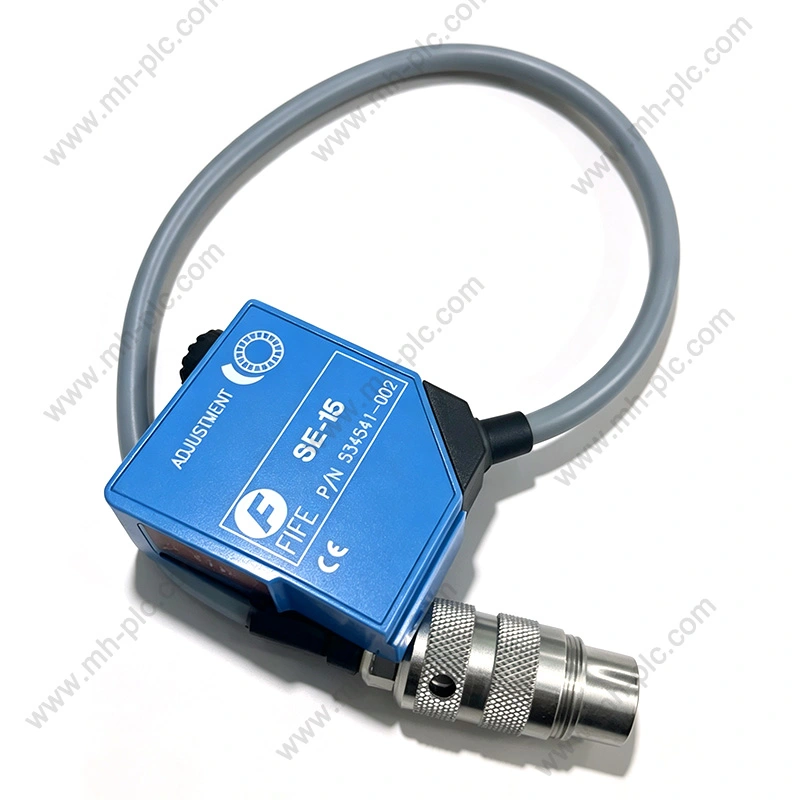
How Does the Maxcess FIFE SE-15 Visible Light Sensor Work?
The Maxcess FIFE SE-15 Visible Light Sensor uses a visible red LED light source to detect the position of a strip or web edge. During operation, light passing beyond the material edge is reflected back toward the sensor. The sensor processes the received light information to determine the edge position and generates a corresponding analog current signal.
When integrated with a compatible web guiding controller and correction mechanism, the sensor helps the system identify deviations and support corrective adjustments. This process is particularly important in production environments where materials must remain aligned throughout unwinding, conveying, processing, and rewinding.
Its compact design is another practical advantage. In machinery with limited mounting space, a small sensor can simplify installation planning without requiring substantial changes to the existing equipment layout.
What Are the Main Technical Features?
Understanding the sensor's technical characteristics helps engineers evaluate whether it matches their application requirements.
| Parameter | Reference Specification |
|---|---|
| Sensor type | Visible-light, medium-gap reflex sensor |
| Light source | Visible red LED |
| Supply voltage | 12 VDC (10–14 VDC) |
| Maximum supply current | 50 mA |
| Analog output | 0–10 mA |
| Sensing range | Up to approximately 1 meter |
| Field of view | Approximately 8–20 mm, depending on distance |
| Operating temperature | 0–60°C |
| Approximate weight | 213 g, including cable |
| Standard cable length | Approximately 0.3 m |
Specifications are based on published SE-15 installation information. Confirm the exact model, configuration, and current documentation before ordering or installation.
These specifications indicate that the SE-15 is intended for applications requiring compact optical edge detection and analog signal integration. However, the sensing distance, material characteristics, mounting geometry, and controller compatibility should all be evaluated before selecting the sensor for a particular production line.
Why Is Accurate Edge Detection Important in Industrial Production?
Accurate edge detection is a fundamental requirement in continuous-web manufacturing. Without effective guiding, material may drift away from its intended path, creating alignment problems that affect subsequent processing stages.
The Maxcess FIFE SE-15 Visible Light Sensor supports edge-position detection, helping a compatible guiding system respond to material movement. Its practical value can be understood through several production considerations.
1. Improved material alignment
Consistent edge detection helps a web guiding system monitor lateral movement and maintain the intended material path. This is particularly useful in applications where precise positioning is necessary for slitting, coating, laminating, printing, or rewinding.
2. Reduced material waste
Uncontrolled web deviation may result in uneven cutting, misaligned printing, or defective finished products. By providing position information to a compatible controller, the sensor can contribute to more consistent processing and help reduce avoidable waste.
3. Better production consistency
Stable edge monitoring supports repeatable processing conditions. When integrated and calibrated correctly, the sensor can help reduce alignment-related interruptions and improve the consistency of production output.
4. Efficient equipment integration
The sensor's compact construction is beneficial when machinery offers limited installation space. It can be considered for equipment upgrades or replacement projects where maintaining the existing mechanical layout is important.
Actual performance depends on the complete guiding system, installation quality, material properties, and operating conditions.
Which Industries Can Benefit From This Sensor?
The Maxcess FIFE SE-15 Visible Light Sensor is intended for web-guiding applications where precise edge detection and compact installation are important.
Potential application areas include:
-
Paper processing: Monitoring paper-web edges during converting and rewinding.
-
Flexible packaging: Supporting web alignment in compatible film and packaging production equipment.
-
Printing operations: Helping maintain material positioning during continuous printing processes.
-
Slitting and rewinding: Providing edge-position feedback to a compatible guiding controller.
-
Industrial material converting: Supporting alignment control for suitable continuous strips and webs.
Application suitability should be verified for each material and machine configuration. Transparent, reflective, or unusually textured materials may require additional testing to establish reliable sensing performance.
How Can Buyers Select the Right Sensor for Their Equipment?
Choosing an industrial sensor involves more than matching a model number. Buyers should consider the operating environment, electrical interface, mechanical dimensions, and intended control function.
Before purchasing the Maxcess FIFE SE-15 Visible Light Sensor, review the following checklist:
-
Confirm the exact model: Verify that SE-15 is the required sensor rather than a related model with a different sensing principle.
-
Check electrical compatibility: Ensure that the supply voltage and 0–10 mA analog output are suitable for the existing controller.
-
Evaluate the sensing distance: Confirm that the available mounting gap falls within the supported operating range.
-
Assess the material: Consider its transparency, reflectivity, surface finish, and edge characteristics.
-
Review installation requirements: Check mounting-hole positions, optical alignment, connector type, and cable length.
-
Verify operating conditions: Confirm that ambient temperature and other environmental factors meet the product requirements.
These checks can help buyers avoid incompatible replacements, reduce commissioning difficulties, and plan maintenance more effectively.
How Does the Sensor Contribute to More Efficient Operations?
The value of an edge sensor extends beyond the detection component itself. Its contribution depends on how effectively it works with the controller, actuator, and mechanical guiding assembly.
A properly integrated sensing system can provide continuous edge-position feedback, enabling the controller to identify deviations and command suitable corrections. This helps maintain alignment during material movement and supports more predictable production.
For maintenance teams, checking sensor mounting stability, optical alignment, electrical connections, and signal response can also help identify potential problems before they lead to extended production interruptions.
The sensor should therefore be evaluated as part of a complete web guiding solution rather than as an isolated component. Appropriate commissioning, routine inspection, and compatibility verification remain essential to achieving reliable results.
Why Work With Dongguan Nancheng Mao Hui Machinery Equipment Trading Co., Ltd.?
Selecting the right industrial component requires accurate model identification, careful specification checking, and a clear understanding of the intended application.
Dongguan Nancheng Mao Hui Machinery Equipment Trading Co., Ltd. can be included in the sourcing process for buyers seeking industrial machinery components and equipment-related procurement support. When evaluating the Maxcess FIFE SE-15 Visible Light Sensor, buyers should provide the required model number, existing equipment information, operating conditions, and any available product label or technical documentation.
This information helps clarify purchasing requirements and supports more efficient communication during component selection. Before placing an order, confirm product availability, condition, delivery arrangements, and the technical compatibility of the proposed component.
For industrial buyers, a well-defined sourcing process can reduce uncertainty, simplify maintenance planning, and support more informed purchasing decisions.
Conclusion
The Maxcess FIFE SE-15 Visible Light Sensor is a compact optical sensing component designed to support precise edge guiding where installation space is limited. Its visible red light sensing principle and analog current output make it a potential option for compatible web guiding systems used in continuous material processing.
By evaluating electrical specifications, sensing distance, material characteristics, and system compatibility, manufacturers can determine whether this sensor meets their operational requirements. Careful selection and correct integration help support consistent web alignment, efficient production, and reduced alignment-related waste.
Looking for the right industrial sensing component for your equipment? Contact us at Dongguan Nancheng Mao Hui Machinery Equipment Trading Co., Ltd. to discuss your model requirements, application details, and sourcing needs. Our team can help you clarify product specifications and identify the information needed for your next procurement decision.
