

Why Are Vacuum Ejectors More Compact Than Traditional Vacuum Pumps?
2026-09-10
1. What Is the Fundamental Difference in Working Principle Between Vacuum Ejectors and Vacuum Pumps?
A traditional vacuum pump generates vacuum through mechanical displacement. A rotary vane pump, for example, uses rotating vanes to trap a volume of air and push it out through an exhaust port. This requires a motor, a shaft, bearings, seals, and a housing that can contain all these moving parts. The result is a device with a large physical footprint. A Vacuum Ejector, by contrast, has no moving parts. It generates vacuum through the Venturi effect. Compressed air is forced through a converging nozzle, which accelerates the air to supersonic speed. This high-speed jet of air creates a low-pressure zone in the diverging section of the ejector. The low pressure draws air from the vacuum port, and the combined flow exits through the exhaust. The entire device consists of a nozzle, a body, and a diffuser—typically machined from brass, aluminum, or stainless steel. In our factory, we manufacture Vacuum Ejectors with a body length of 40 to 80 mm and a diameter of 15 to 30 mm.
Component comparison:
• Vacuum pump: motor, shaft, bearings, vanes, seals, oil reservoir, cooling fan, housing, base plate — 200 to 500 components
• Vacuum ejector: nozzle, body, diffuser, O-rings — 4 to 8 components
Zhejiang Jika Hardware Manufacturing Co., Ltd. has been producing Vacuum Ejectors for over 15 years. The simplicity of the design is what enables the compact size. There are no bearings to wear out, no oil to change, and no motor to overheat. The entire device can be mounted directly on the suction cup or on the robot arm, eliminating the need for long vacuum lines that reduce response time.
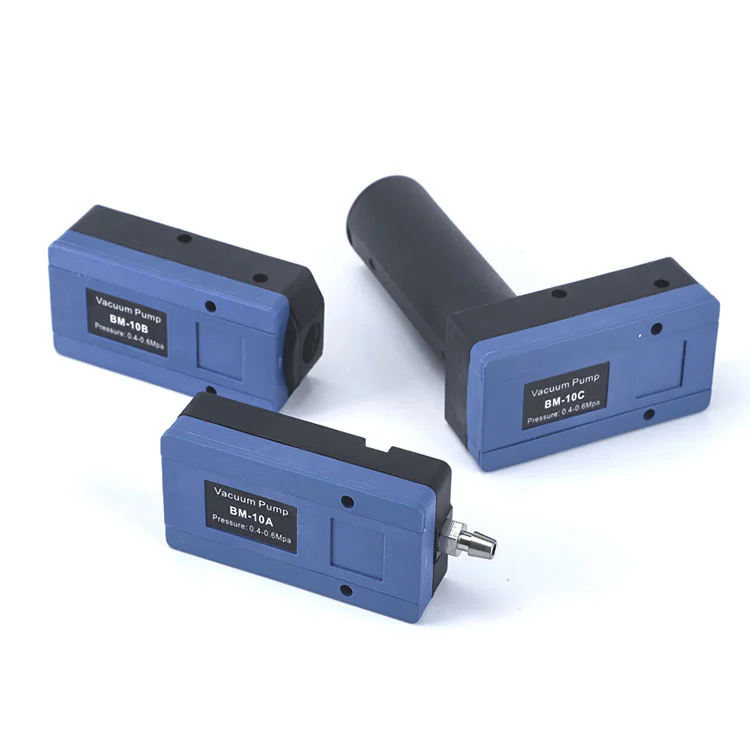
2. How Does the Absence of a Motor and Moving Parts Reduce the Physical Footprint?
The motor is the largest single component of a traditional vacuum pump. A 1 kW motor occupies a volume of 3 to 5 liters and weighs 8 to 12 kg. The pump housing, oil reservoir, and cooling system add another 10 to 20 liters. A Vacuum Ejector that delivers the same vacuum flow rate (20 to 40 m³/h) weighs less than 500 grams and occupies a volume of less than 0.2 liters. The table below compares the physical characteristics of a typical vacuum pump and a Vacuum Ejector of equivalent capacity.
| Physical parameter | Rotary vane vacuum pump (1 kW) | Vacuum Ejector (equivalent capacity) |
| Length (mm) | 350 – 450 | 40 – 80 |
| Width (mm) | 200 – 250 | 15 – 30 |
| Height (mm) | 250 – 300 | 15 – 30 |
| Volume (liters) | 18 – 30 | 0.02 – 0.07 |
| Weight (kg) | 15 – 25 | 0.1 – 0.5 |
| Mounting orientation | Must be horizontal (oil lubrication) | Any orientation |
The volume difference is a factor of 300 to 1,000. This is why Vacuum Ejectors are used in applications where a vacuum pump cannot fit: robotic end effectors, pick-and-place heads, portable clamping devices, and medical equipment. In our factory, we produce Vacuum Ejectors in single-stage and multi-stage configurations. The multi-stage design uses two or three Venturi nozzles in series to achieve a higher vacuum level without increasing the body diameter significantly.
3. What Are the Installation and System Integration Advantages of Compact Vacuum Ejectors?
The compact size of a Vacuum Ejector is not just about fitting into tight spaces. It also simplifies the entire vacuum system. A traditional vacuum pump requires a centralized installation with rigid piping running to each point of use. The piping introduces pressure losses and increases the response time. A Vacuum Ejector can be mounted directly at the point of use, eliminating the long vacuum lines. This reduces the air volume that must be evacuated, which improves the cycle time. The table below compares the system integration characteristics of the two approaches.
| System integration factor | Centralized vacuum pump | Distributed Vacuum Ejectors |
| Piping required | Extensive, rigid vacuum lines | None (ejector mounted at point of use) |
| Response time | 1 – 3 seconds (due to line volume) | 0.1 – 0.3 seconds |
| Energy consumption | Continuous (pump runs even when vacuum is not needed) | On-demand (compressed air only when ejector is activated) |
| Maintenance | Oil changes, filter replacement, vane replacement | No routine maintenance |
| Redundancy | Single point of failure | Multiple independent units |
The on-demand operation of Vacuum Ejectors is a significant advantage in applications where vacuum is only needed intermittently. A centralized pump must run continuously to maintain vacuum in the system, even when no suction cups are active. A Vacuum Ejector consumes compressed air only when it is activated. In a packaging machine with 10 pick-and-place stations, the energy saving from on-demand operation can be 40 to 60 percent compared to a centralized pump. Zhejiang Jika Hardware Manufacturing Co., Ltd. provides Vacuum Ejectors with integrated solenoid valves that allow direct control from the machine's PLC, further simplifying the system design.
4. When Should You Choose a Vacuum Ejector Over a Vacuum Pump?
The choice between a Vacuum Ejector and a vacuum pump depends on the application requirements. Vacuum Ejectors are the preferred choice when space is limited, when the vacuum is needed intermittently, when compressed air is already available, and when maintenance access is difficult. Vacuum pumps are preferred when a high vacuum level (below 10 mbar) is required, when the application is continuous and the flow rate is high, and when compressed air is not available. The table below provides a decision guide.
Choose Vacuum Ejectors when: Space is constrained, vacuum is intermittent, compressed air is available, maintenance access is limited, or multiple independent vacuum points are needed.
Choose a vacuum pump when: High vacuum (below 10 mbar) is required, continuous high-flow vacuum is needed, or compressed air is not available.
Frequently Asked Questions About Vacuum Ejectors and Vacuum Pump Comparison
Summary for Equipment Engineers
Vacuum Ejectors are more compact than traditional vacuum pumps because they generate vacuum through the Venturi effect rather than mechanical displacement. The absence of a motor, bearings, and oil reservoir reduces the size and weight by a factor of 300 to 1,000. This compactness enables direct mounting at the point of use, eliminating long vacuum lines and improving response time. While Vacuum Ejectors cannot achieve the deep vacuum of a rotary vane pump, they are the preferred solution for the majority of industrial vacuum handling applications where space, weight, and simplicity are priorities.
Zhejiang Jika Hardware Manufacturing Co., Ltd. manufactures Vacuum Ejectors in single-stage and multi-stage configurations, with optional integrated solenoid valves and filters. We provide full technical data and application support for system integration.
