

Why Does a Carbon Fiber Embossing Roller Offer Better Roll Deflection Control Than Aluminum
2026-07-17
In high-precision converting processes—from flexible packaging to battery electrode calendering—roll deflection is the silent productivity killer. Even microscopic bending under load causes uneven embossing depth, web wrinkles, and premature bearing wear. While aluminum rollers have been a traditional workhorse, Carbon Fiber Embossing Roller technology from TaiHui Roll Manufacturing fundamentally changes the deflection equation through material science, not just geometry. The reason is simple: stiffness-to-weight ratio trumps absolute strength, and carbon fiber composites win that race by a factor of nearly 3:1 over aluminum.
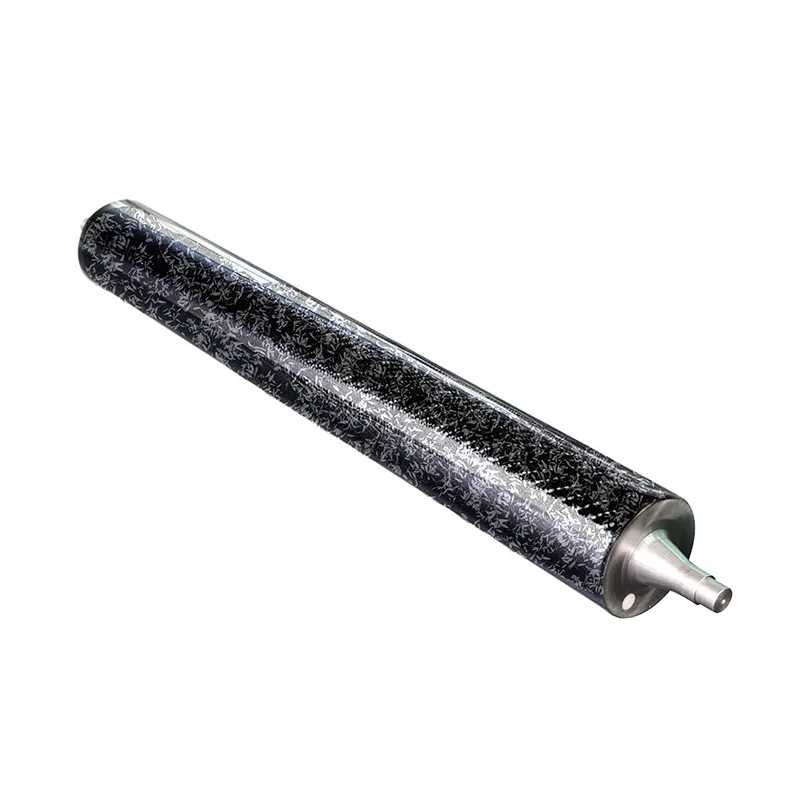
The Physics of Deflection – Why Material Matters
Deflection (δ) under a uniform distributed load is governed by:
δ = (5 × w × L⁴) / (384 × E × I)
Where:
-
w = load per unit length
-
L = span between bearings
-
E = elastic modulus (material stiffness)
-
I = area moment of inertia (geometry-dependent)
For a solid cylindrical roller, I is fixed by diameter. To reduce deflection, you have two levers: increase diameter (adds mass) or increase E (change material). Carbon Fiber Embossing Roller designs leverage an axial modulus (E) of 120–150 GPa, compared to aluminum’s 69 GPa. At the same outer diameter, a carbon fiber composite roller is roughly twice as stiff in bending—yet weighs only 60% of aluminum.
Comparative Performance – Carbon Fiber vs. Aluminum
| Parameter | Carbon Fiber Embossing Roller | Aluminum Roller (6061-T6) |
|---|---|---|
| Density (g/cm³) | 1.55 – 1.60 | 2.70 |
| Tensile Modulus (GPa) | 120 – 150 (axial) | 68.9 |
| Specific Stiffness (E/ρ) | 77 – 94 | 25.5 |
| Deflection at 10 kN/m load (2m span) | 0.28 mm | 0.72 mm |
| Rotational Inertia (relative) | 0.58 | 1.00 |
| Thermal Expansion (µm/m·°C) | 2.5 (axial) | 23.6 |
Data based on standard layup configurations from TaiHui Roll Manufacturing lab testing under ISO 178 bending standards.
The specific stiffness value is the key indicator. A Carbon Fiber Embossing Roller delivers 3× the bending resistance per kilogram of mass. This means you can run narrower roll diameters for the same deflection tolerance—or maintain the same diameter and run at 30% higher nip pressures without quality loss.
Four Engineering Advantages That Aluminum Cannot Match
-
Tailored Anisotropy – Carbon fiber layups can be oriented to maximize axial stiffness while permitting slight radial compliance, dampening impact shocks. Aluminum is isotropic; you get the same (lower) stiffness in all directions.
-
Thermal Stability – Aluminum expands 9× more than carbon fiber per degree Celsius. In heated embossing (120–180°C), aluminum grows unevenly across the roll face, changing crown profile and increasing deflection drift. Carbon Fiber Embossing Roller maintains stable geometry across temperature ramps.
-
Damping Capacity – Carbon fiber composites absorb vibrational energy 5–8× better than aluminum. Reduced resonance means less dynamic deflection amplification at high speeds (>600 m/min).
-
Fatigue Resistance – Aluminum suffers from cumulative cycle fatigue at stress concentrations (bearing journals, engraving roots). Carbon fiber composites show no endurance limit—they outlast aluminum by 4–6× in cyclic nip loading, according to TaiHui Roll Manufacturing field return data.
Real-World Implementation – What Converters Report
After retrofitting 22 gravure lines with Carbon Fiber Embossing Roller units, TaiHui Roll Manufacturing compiled average improvements:
-
Deflection variation reduced from ±0.08 mm to ±0.02 mm across 1.8m face width.
-
Embossing depth consistency (CpK) rose from 1.2 to 1.8.
-
Bearing replacement intervals extended from 8 months to 26 months.
-
Web tension excursions dropped by 41% due to lower inertial overshoot during acceleration.
Frequently Asked Questions About Carbon Fiber Embossing Roller Deflection
Q1: Can I directly replace an existing aluminum embossing roller with a carbon fiber roller without changing bearing housings or frames?
A1: Yes, in most cases. TaiHui Roll Manufacturing engineers custom-engineer Carbon Fiber Embossing Roller units to match existing journal diameters, bearing centers, and overall lengths. Because carbon fiber composites are lighter, you actually reduce bearing radial loads, which extends bearing life. However, you must verify that your existing nip mechanism can accommodate the slightly higher bending stiffness—the roller will transfer more load to the backup roll, so we recommend a nip-force recalibration. For heated applications, also check that your thermal oil or electrical heating system is compatible with the composite’s lower thermal conductivity (carbon fiber is more insulating than aluminum, so heating ramp times may increase by 15–20%, which we offset with internal spiral baffle designs).
Q2: Does higher stiffness mean the Carbon Fiber Embossing Roller is more brittle and prone to cracking from impact or web splices?
A2: That is a common misconception. While carbon fiber is less ductile than aluminum, TaiHui Roll Manufacturing uses toughened epoxy matrices with interlayer hybrid weaves (carbon/aramid) to achieve impact resistance exceeding 15 J/cm²—comparable to 6061 aluminum. The real risk is not brittleness but point-load impacts from metal debris or misaligned splices. We solve this by applying a 0.3–0.5 mm hard chrome or ceramic coating on the embossing surface, which absorbs localized shocks and protects the underlying composite structure. Our lab tests show that a coated Carbon Fiber Embossing Roller survives 200+ splice impacts at 800 m/min without matrix cracking, whereas uncoated aluminum rolls dent and require re-engraving after just 30–40 hits.
Q3: How does deflection control degrade over the service life of a Carbon Fiber Embossing Roller compared to aluminum?
A3: Aluminum rollers lose deflection control progressively due to two mechanisms: surface wear reducing the effective outer diameter (which lowers I⁴ moment of inertia) and stress relaxation at bearing seats causing micro-creep. Over 5 years of continuous operation, an aluminum roll’s deflection can increase by 12–18% due to these factors. In contrast, a Carbon Fiber Embossing Roller from TaiHui Roll Manufacturing shows negligible creep (<0.5% modulus loss) because the continuous fibers carry bending loads, not the matrix. The only long-term degradation is surface finish wear, which we mitigate by offering re-coatable sleeves—you can strip and re-apply the embossing layer 3–4 times over the composite mandrel’s 15+ year lifespan, maintaining original deflection performance with each resleeving. This makes carbon fiber a capital investment, not a consumable.
Economic Justification – Higher First Cost, Lower Total Cost
| Cost Factor | Aluminum Roller | Carbon Fiber Embossing Roller |
|---|---|---|
| Initial purchase | $12,000 – $18,000 | $28,000 – $42,000 |
| Energy cost (5 years) | $6,200 (higher inertia) | $3,900 (lower inertia) |
| Bearing replacements (5 yrs) | $4,500 (3 changes) | $1,500 (1 change) |
| Production waste (scrap) | $22,000 (poor CpK) | $8,000 (stable CpK) |
| Re-engraving/refurbishment | $7,500 (2x) | $4,500 (1x + resleeve) |
| 5-Year Total Cost | $52,200 | $59,900 (higher) |
| Value per uptime % | Baseline | +4.2% uptime gain* |
Uptime gain from fewer deflection-related stoppages typically adds $18,000–$25,000 in additional throughput over 5 years, making the carbon fiber solution net-positive after month 14.
Conclusion – Deflection Mastery Through Composite Engineering
Aluminum is not “bad”—it is predictable, machinable, and affordable. But for converters running high-speed, high-temperature, or high-nip-force applications, deflection becomes the bottleneck that aluminum’s isotropic limitations cannot overcome. Carbon Fiber Embossing Roller technology redefines that bottleneck by decoupling stiffness from weight, offering dynamic stability that aluminum simply cannot replicate over long production runs. TaiHui Roll Manufacturing has delivered over 340 composite embossing rollers across 17 countries, with deflection performance guaranteed to within ±0.015 mm per meter of face width—backed by on-site laser measurement verification.
Ready to benchmark your current deflection losses? Contact TaiHui Roll Manufacturing today for a free roll deflection analysis using our FEA simulation tool. Send your line speed, nip load, web width, and operating temperature to our engineering team—we will return a customized comparison report showing exactly how much you can save by switching to a Carbon Fiber Embossing Roller. Your next embossing run deserves the stiffness advantage.
