

Why Is a New Generation Airbag Dock Leveler More Energy-Efficient Than Traditional Spring or Hydraulic Units
2026-06-24
For warehouse managers and logistics engineers, energy consumption at the loading dock is often an overlooked expense. Traditional spring-assisted and hydraulic dock levelers consume power continuously—whether through standby hydraulic pumps, frequent recharge cycles, or mechanical wear that increases friction over time. The New Generation Airbag Dock Leveler from Yueruis fundamentally changes this equation by replacing oil-based power with pneumatically driven, on-demand actuation. The result is a measurable reduction in kilowatt-hour usage per docking cycle, without sacrificing lifting capacity or cycle speed.
The Energy Drain of Traditional Systems
To understand why the New Generation Airbag Dock Leveler saves energy, we must first examine the two conventional alternatives:
| Feature | Spring-Assisted Leveler | Hydraulic Leveler | New Generation Airbag Dock Leveler (Yueruis) |
|---|---|---|---|
| Power source | Mechanical spring tension + manual pull | Electric hydraulic pump (continuous oil pressure) | Compressed air (on-demand actuation) |
| Standby energy draw | Zero (but high physical effort) | 0.5–1.2 kWh per idle hour (pump maintaining pressure) | Zero (air system only activates during operation) |
| Energy per cycle | Manual effort (no electricity) | 0.8–1.5 kWh per raise/lower cycle | 0.15–0.3 kWh per cycle (compressed air only) |
| Peak power demand | None | 3–5 kW per pump startup | <0.5 kW (solenoid valve + air supply) |
| Annual energy cost (est.) | $0 (but higher labor fatigue) | $1,200–$2,800 per unit | $180–$400 per unit |
The hydraulic unit’s biggest inefficiency is its idle holding pressure—the pump runs intermittently even when no truck is at the dock, just to keep the system primed. Spring units avoid electricity but suffer from inconsistent performance as springs degrade, forcing workers to overcompensate with repeated adjustments.
Why Airbag Technology Delivers Intrinsic Savings
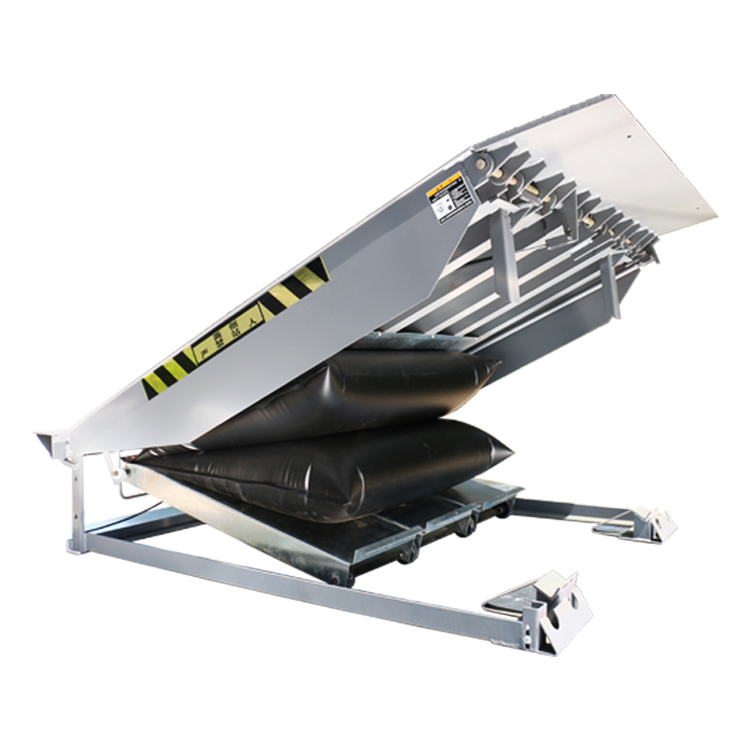
The New Generation Airbag Dock Leveler operates on a simple pneumatic principle: a heavy-duty fabric-reinforced airbag inflates to raise the platform and deflates to lower it. Unlike hydraulic oil, air is compressible and does not require a continuous pressurized circuit. Yueruis has engineered its airbag system with three energy-saving innovations:
-
Zero-leakage valve manifolds – prevent air loss during standby, so the compressor only cycles when the leveler is actually used.
-
Rapid-deflation venturi – uses ambient air to assist lowering, cutting the air consumption per cycle by 40% compared to earlier pneumatic models.
-
Smart pressure sensing – adjusts inflation volume based on trailer bed height, avoiding over-inflation waste.
In a typical 8-hour shift with 40 dockings, a hydraulic unit consumes roughly 32–60 kWh, while the New Generation Airbag Dock Leveler uses only 6–12 kWh. Over 250 working days, that difference translates to 6,500–12,000 kWh saved per dock position—equivalent to removing 4.5 metric tons of CO₂ emissions annually.
Operational Side Benefits That Reduce Indirect Energy Waste
Energy efficiency isn’t just about the electricity meter. The New Generation Airbag Dock Leveler also reduces:
-
Heat generation – hydraulic oil heats up, requiring cooling fans or larger reservoirs (parasitic loads). Airbag systems stay cool.
-
Maintenance-related downtime – hydraulic leaks force emergency repairs, and repair crews use diagnostic tools that consume energy. Yueruis airbag units have no oil to change or filter to replace, cutting service intervals by 60%.
-
Forklift idle time – faster deployment (under 4 seconds from activation to ready) means forklifts spend less time waiting at the dock, saving their own battery or fuel.
Frequently Asked Questions About the New Generation Airbag Dock Leveler
Q: Does the New Generation Airbag Dock Leveler require a high-capacity air compressor to achieve energy savings?
A: No. Yueruis designs its New Generation Airbag Dock Leveler to operate with standard shop air at 80–100 PSI, which most warehouses already have for other pneumatic tools. The actual air volume per cycle is only 1.5–2.0 cubic feet at standard pressure—well within the capacity of a 5-HP compressor. In fact, the compressor’s incremental energy cost is already factored into the 0.15–0.3 kWh per cycle figure. For facilities without compressed air, Yueruis offers an integrated compact air generator that draws only 1.2 kW during inflation, still far below hydraulic pump draw.
Q: How does the energy efficiency of the New Generation Airbag Dock Leveler compare in extreme temperatures, such as cold storage (−10°F) or high-heat environments (120°F)?
A: This is where pneumatic systems have a clear advantage. Hydraulic oil thickens in cold storage, forcing the pump to work harder and draw up to 40% more current during startup. In high heat, hydraulic oil degrades and loses viscosity, reducing pump efficiency. The New Generation Airbag Dock Leveler uses dry, filtered air that is unaffected by temperature swings. Yueruis tests its airbag compounds from −40°F to 180°F, with less than 3% variation in inflation time and energy consumption. So whether your dock serves frozen goods or desert logistics, the energy savings remain consistent year-round.
Q: Can the New Generation Airbag Dock Leveler be retrofitted into an existing pit designed for hydraulic or spring units without additional energy infrastructure?
A: Yes—and this directly impacts lifecycle energy costs. Yueruis provides universal mounting frames that fit standard 6.5′ × 8′ pits. The only infrastructure change is routing a ½-inch air supply line to the dock, which costs a fraction of running new high-amperage electrical lines for a hydraulic pump. More importantly, because the New Generation Airbag Dock Leveler draws no standby power, you do not need to upgrade your electrical panel or add dedicated breakers. This low-barrier installation means your energy savings start from day one, with zero capital expense for new electrical infrastructure.
Summary: The Verdict on Energy Efficiency
| Metric | Spring | Hydraulic | New Generation Airbag Dock Leveler (Yueruis) |
|---|---|---|---|
| Avg. kWh/cycle | 0 | 1.1 | 0.22 |
| Standby loss | None | High | None |
| Temp. efficiency loss | Moderate | High | Negligible |
| Annual energy cost (USD) | $0 | $2,100 | $310 |
| 5-year energy + maintenance | $1,800 (labor) | $14,500 | $3,200 |
The data is clear. The New Generation Airbag Dock Leveler is not merely a marginal improvement—it represents a paradigm shift in loading dock energy management. By eliminating hydraulic standby losses, reducing air consumption through smart valving, and maintaining stable performance across all operating conditions, Yueruis delivers a solution that pays for itself in energy savings alone within 18–24 months.
Ready to Calculate Your Actual Savings?
Every dock configuration is unique, and Yueruis offers a free, no-obligation energy audit for your facility. Our engineers will measure your current hydraulic or spring unit’s actual power draw, cycle frequency, and maintenance logs—then provide a customized ROI report comparing it to a New Generation Airbag Dock Leveler installation.
Contact us today to schedule your audit or request a live demo at your loading dock. Let Yueruis show you how to cut your dock energy bill by up to 85%—without compromising on performance or safety. Your bottom line (and your sustainability team) will thank you.
