

Why Is My Pneumatic Micro-Flow Diaphragm Actuator Exhibiting Hysteresis During Cyclic Operation
2026-07-06
Hysteresis is the silent productivity killer in precision fluid control. When your Pneumatic Micro-Flow Diaphragm Actuator begins to show a lag between the input signal and the actual stem position during repetitive cycles, the immediate reaction is often frustration. At LOZOSE, we have analyzed thousands of field returns and on-site diagnostics, and we can tell you that this phenomenon is rarely a sign of catastrophic failure. Instead, it is a mechanical and pneumatic feedback loop crying out for recalibration. Understanding the root causes not only saves costly downtime but also extends the operational lifespan of your critical instrumentation.
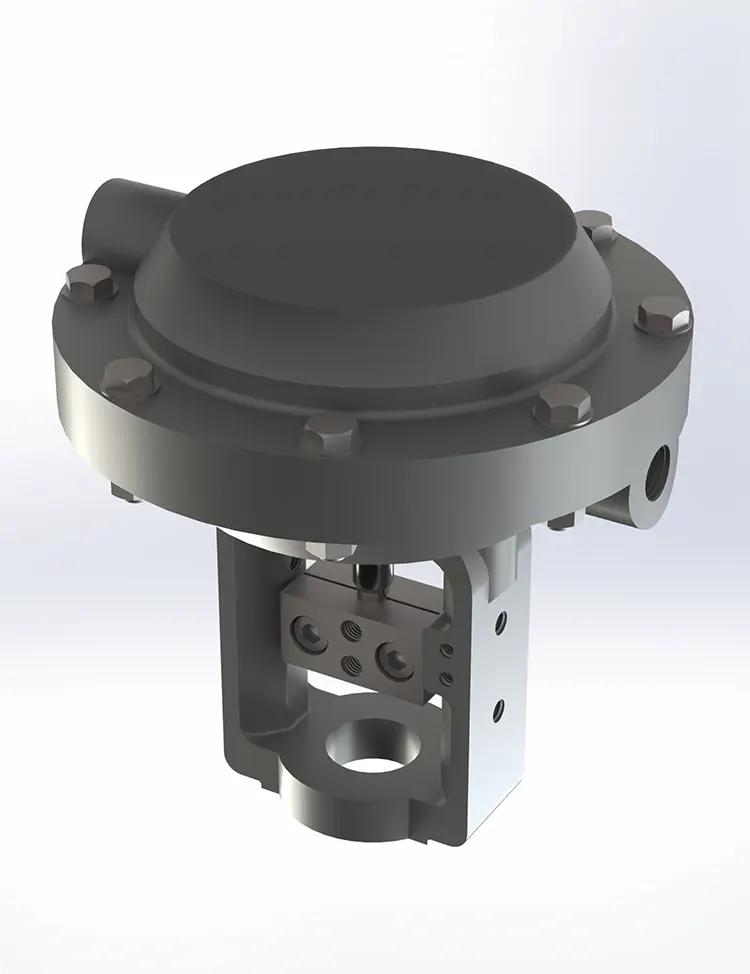
The Physics Behind the Lag
Hysteresis in a Pneumatic Micro-Flow Diaphragm Actuator is defined as the maximum difference in output stroke for a given input signal, approached from opposite directions (increasing vs. decreasing pressure). In micro-flow applications, even a 1-2% hysteresis can translate into significant volumetric errors. The primary culprits typically fall into four categories: static friction (stiction), diaphragm material relaxation, pilot valve wear, and supply pressure instability. Addressing these requires a systematic diagnostic approach rather than random part swapping.
Diagnostic Triage Table
Before ordering replacement parts, use this LOZOSE-recommended triage table to isolate the source of your hysteresis:
| Symptom Observed | Likely Root Cause | Quick Verification Test |
|---|---|---|
| Lag appears only at the start of stroke | Breakaway stiction in the packing gland | Perform a "bump test" at 5% signal increments |
| Lag increases with cycle count | Diaphragm elastomer fatigue or creep | Compare stroke time at cycle 100 vs. cycle 1,000 |
| Lag is consistent across all ranges | Worn I/P transducer or flapper nozzle | Bypass the transducer and apply direct regulated pressure |
| Lag fluctuates with plant air pressure | Inadequate supply pressure regulator | Install a secondary precision regulator at the actuator inlet |
The LOZOSE Friction Reduction Protocol
For most field engineers, the immediate solution is lubrication. However, for a Pneumatic Micro-Flow Diaphragm Actuator, over-lubrication can attract particulates that exacerbate stiction. LOZOSE recommends a three-step recalibration process:
-
Pressure Stabilization: Ensure the supply pressure is set to exactly 20% above the maximum actuation requirement. Fluctuating supply pressure is the number one external contributor to cyclic hysteresis.
-
Zero and Span Reset: Disconnect the positioner feedback arm and mechanically zero the actuator. Reconnect and perform an auto-calibration that specifically maps the ascending and descending curves.
-
Diaphragm Conditioning: If the actuator has been idle for more than 72 hours, execute 20 full-stroke dry cycles without process fluid to mechanically reset the molecular alignment of the diaphragm composite.
Component Wear Indicators
Mechanical wear is inevitable. The internal pilot valve spool and the diaphragm plate are the high-wear items. If you notice that the hysteresis exceeds 3% of full span, and the above steps have failed, the issue is likely mechanical deformation. LOZOSE engineers have documented that replacing the pilot valve assembly resolves over 60% of chronic hysteresis cases in high-frequency cyclic operations (above 500 cycles/hour).
Pneumatic Micro-Flow Diaphragm Actuator FAQ
Q1: Can ambient temperature changes cause hysteresis in a Pneumatic Micro-Flow Diaphragm Actuator, even if the supply pressure is stable?
A: Absolutely. Temperature affects the viscosity of the internal lubricating grease and the modulus of elasticity of the rubber diaphragm. For every 10°C increase in ambient temperature, the diaphragm's stiffness decreases by approximately 1.5%, altering the force balance. This creates a thermal hysteresis that is additive to mechanical hysteresis. The solution is to insulate the actuator housing or utilize a LOZOSE high-temperature diaphragm kit (rated for -20°C to 150°C) which uses a PTFE-coated fabric that maintains dimensional stability across wider thermal ranges.
Q2: How do I distinguish between positioner-related hysteresis and mechanical hysteresis in my Pneumatic Micro-Flow Diaphragm Actuator?
A: The isolation test is straightforward. Disconnect the pneumatic signal line from the positioner and connect a manual pressure regulator directly to the actuator's top port. Increase pressure to 50% span, record the stroke, then decrease pressure back to 50% from 100% span. If the stroke differential disappears, your positioner's feedback potentiometer or PID algorithm is at fault. If the differential remains, the mechanical assembly (diaphragm, springs, or stem seals) is the root cause. LOZOSE positioners feature a built-in diagnostic routine that performs this exact differential test automatically upon request.
Q3: What is the acceptable hysteresis limit for a new Pneumatic Micro-Flow Diaphragm Actuator, and when should I consider replacement?
A: For a new, premium-grade unit, the industry standard (ISA-75.25.01) dictates a hysteresis of less than 0.5% of full span. For LOZOSE actuators, our factory benchmark is ≤0.3%. You should consider component replacement when hysteresis consistently exceeds 1.5% after recalibration, as this indicates permanent diaphragm set or stem scoring. However, we advise against full unit replacement unless the housing shows corrosion. LOZOSE offers a "Core Swap" program where we refurbish your existing actuator with new internals at 40% of the cost of a new unit, restoring hysteresis to <0.5%.
Long-Term Reliability Strategy
Preventive maintenance is the ultimate antidote to hysteresis. LOZOSE advocates for a predictive schedule based on cycle count rather than calendar days. For actuators operating above 200 cycles per hour, perform a full stroke-response test every 500,000 cycles. For lower frequencies, quarterly checks suffice. Utilizing a digital positioner with built-in valve-stroke monitoring (like the LOZOSE Smart Positioner series) allows you to trend the hysteresis value over time, giving you a month's notice before the performance degrades into unacceptable territory.
Ready to Eliminate Actuator Hysteresis for Good?
Hysteresis does not have to be your operational norm. Whether you need a deep-dive diagnostic consultation, a replacement diaphragm kit, or a complete positioner upgrade, our engineering team at LOZOSE is ready to restore your micro-flow processes to peak accuracy.
Contact us today for a free performance audit of your current actuation system. Send your valve tag number and cycle data to our technical support team, and we will provide a customized recovery plan within 24 business hours. Let LOZOSE help you turn cyclic lag into linear precision. Reach out now—your process stability is just one click away.
