

Why Is Nickel Plating Necessary for Neodymium Ring Magnets?
2026-10-15
A Ring Magnet made from neodymium iron boron, commonly known as NdFeB, delivers strong magnetic performance in a compact annular shape. However, the material is vulnerable to oxidation and corrosion when exposed to moisture, humidity, and certain chemicals. Nickel plating provides a protective surface layer that helps reduce these risks while improving the magnet's resistance to everyday handling and surface wear. For engineers sourcing permanent magnets for motors, sensors, magnetic couplings, speakers, and automation equipment, understanding the coating system is essential. At Xiamen Zhaobao Magnet Co., Ltd., our material selection and coating considerations focus on the relationship between the operating environment, dimensional requirements, magnetic performance, and expected service life.
What Makes Neodymium Magnets Vulnerable to Corrosion?
Neodymium magnets offer a high magnetic energy product relative to their size, making them useful where compact dimensions and strong magnetic fields are important. Their composition typically includes neodymium, iron, and boron, with additional alloying elements depending on the specified grade. The iron-rich composition, combined with the microstructure of the sintered material, makes untreated surfaces susceptible to corrosion under unsuitable environmental conditions.
When moisture reaches an unprotected magnet surface, oxidation can develop and gradually damage the material. In humid industrial settings, condensation and repeated wetting can accelerate surface deterioration. Corrosion may cause discoloration, roughness, flaking, or local material loss. If deterioration progresses, the magnet can lose structural integrity, and its performance may become less predictable.
The risk is not limited to outdoor equipment. Magnets installed inside motors, pumps, electronic assemblies, and industrial sensors may encounter condensation, cleaning residues, or humid air during operation and storage. A component enclosed within a housing is not automatically protected from moisture, particularly when temperature changes create condensation.
Our approach is to evaluate the complete service environment before recommending a surface finish. Temperature, relative humidity, chemical exposure, handling, and the design of the surrounding assembly all affect coating requirements. Nickel plating is a widely used solution for sintered NdFeB magnets, but it should be selected according to the actual exposure conditions rather than treated as a universal corrosion-proof barrier.
How Does Nickel Plating Protect the Magnet Surface?
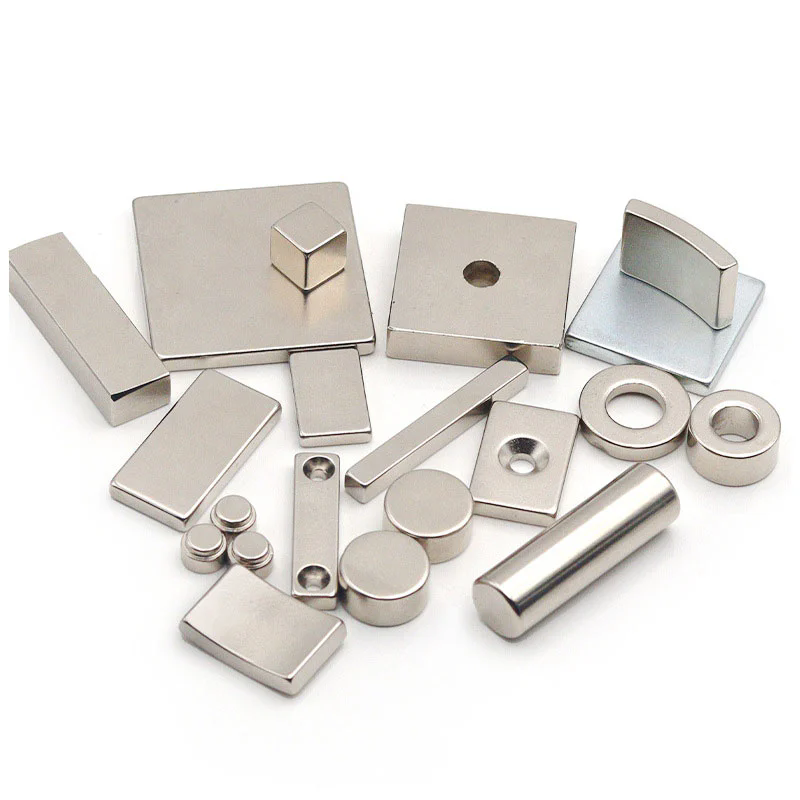
Nickel plating creates a metallic coating over the magnet, reducing direct exposure of the underlying material to the surrounding environment. Commercial NdFeB magnets commonly use a nickel copper nickel coating system, often abbreviated as Ni Cu Ni. This multilayer construction combines different metallic layers to improve corrosion protection and surface durability compared with an untreated magnet.
In a typical Ni Cu Ni system, the first nickel layer provides a plated foundation, the intermediate copper layer supports the coating structure, and the outer nickel layer supplies the finished surface. The precise layer sequence, thickness, and processing conditions depend on the manufacturer's specification. Proper surface preparation and plating quality are important because coating adhesion and coverage influence how effectively the system protects the substrate.
| Coating parameter | Typical specification or characteristic |
| Common coating system | Nickel copper nickel, also written as Ni Cu Ni |
| Typical total coating thickness | Approximately 10 to 25 micrometres for many commercial applications, subject to specification |
| Surface appearance | Usually bright silver or metallic grey, depending on the plating process |
| Primary function | Reduce exposure to moisture and help limit corrosion of the NdFeB substrate |
| Additional benefit | Provides a relatively hard surface that can tolerate normal handling and assembly contact |
| Key limitation | Scratches, pores, exposed edges, and coating damage can create pathways for corrosion |
| Quality considerations | Coating adhesion, coverage, thickness consistency, and environmental test requirements |
The thickness shown is a general commercial reference, not a guaranteed specification for every magnet. Increasing coating thickness does not automatically deliver proportionally better protection. The result depends on coating uniformity, substrate preparation, edge coverage, and the environment in which the component operates.
Nickel plating also changes the surface characteristics of the magnet, which can be useful during handling and assembly. However, it is not intended to increase the intrinsic magnetic energy product of the NdFeB material. Magnetic strength is primarily determined by the magnet grade, geometry, magnetization direction, working temperature, and magnetic circuit design.
At Xiamen Zhaobao Magnet Co., Ltd., our coating requirements should be matched to the intended application and drawing. For assemblies with tight dimensional tolerances, the coating thickness must be included in the finished dimensions because it adds material to the magnet's outer diameter, inner diameter, and axial surfaces.
Which Product Parameters Matter When Specifying a Plated Magnet?
Choosing the correct magnet involves more than specifying a coating. The geometry, magnetic grade, operating temperature, dimensional tolerance, magnetization direction, and surface finish all influence whether the component will work reliably in the finished assembly.
For an annular magnet, buyers should define the outer diameter, inner diameter, and thickness. These measurements determine the available space for installation and influence the magnetic field distribution. The required magnetization direction must also be stated clearly. Axially magnetized parts have north and south poles on opposite flat faces, whereas diametrically magnetized designs have poles on opposite sides of the cylindrical circumference. Other multipole configurations may be required for specialized applications.
| Product parameter | What buyers should specify | Why it matters |
| Material grade | Required NdFeB grade, such as an agreed N or temperature-rated grade | Determines magnetic properties and influences temperature suitability |
| Outer diameter | Nominal dimension and tolerance | Controls housing clearance and fit |
| Inner diameter | Nominal bore size and tolerance | Affects shaft clearance and assembly alignment |
| Thickness | Axial dimension and tolerance | Influences fit and magnetic circuit geometry |
| Magnetization direction | Axial, diametrical, radial, or specified multipole pattern | Determines how the magnetic field interacts with surrounding components |
| Coating system | Ni Cu Ni or another approved finish | Defines surface protection and compatibility with the application |
| Coating thickness | Agreed nominal value and acceptable variation | Contributes to final dimensions and coating performance |
| Operating temperature | Continuous and peak temperatures | Helps determine the appropriate magnetic grade and coating qualification |
| Inspection requirements | Dimensional, magnetic, coating, and environmental acceptance criteria | Establishes a measurable basis for supplier quality control |
Magnetic grades are commonly identified by designations such as N35, N42, or N52, with additional suffixes used for certain temperature-resistant grades. These designations should not be interpreted as direct measures of corrosion resistance. A higher magnetic grade does not inherently provide a better coating or a longer corrosion life.
Our factory should also account for the coating allowance when confirming final dimensions. If the drawing specifies a finished outer diameter or bore with a narrow tolerance, the manufacturing process must consider the deposited layer on the relevant surfaces. This is especially important for press-fit assemblies, small motor components, and precision magnetic couplings.
For quality assurance, purchasers may request material certificates, dimensional inspection results, magnetic property data, coating thickness measurements, and corrosion test reports where relevant. Test methods and acceptance criteria should be agreed in advance. A coating thickness measurement alone cannot establish long-term corrosion resistance because it does not fully characterize porosity, adhesion, edge coverage, or actual exposure conditions.
When Is Nickel Plating Suitable for Industrial Applications?
Nickel-plated NdFeB magnets are commonly used in motors, generators, speakers, magnetic sensors, automation systems, magnetic couplings, and various consumer electronics. In these applications, the coating helps protect the surface during storage, handling, and service under conditions compatible with the specified finish.
For motor and generator assemblies, the magnet grade and maximum working temperature must be selected alongside the coating. Excessive heat can reduce magnetic performance, while thermal cycling may place additional stress on the coating and substrate. The coating itself should therefore be qualified for the actual operating range, rather than selected solely because it is a common commercial finish.
In sensors and electronic equipment, dimensional consistency and surface condition can be important for repeatable assembly. Nickel plating can provide a relatively smooth metallic finish, but the actual roughness and dimensional accuracy depend on substrate preparation and process control. Where the component is installed with adhesive, compatibility between the adhesive and the plated surface should be evaluated before production.
Our technical assessment considers whether the magnet will experience occasional humidity, continuous condensation, salt spray, chemical cleaning, or immersion. Standard nickel plating may be suitable for many indoor and controlled industrial environments, but it should not be assumed adequate for prolonged immersion, marine exposure, or aggressive chemical contact without validation.
Where corrosion risk is severe, alternative coatings or encapsulation systems may be more appropriate. Epoxy coatings are often considered for applications requiring stronger environmental protection, while other metallic finishes may be selected for specific electrical, mechanical, or assembly requirements. Each option has trade-offs in thickness, adhesion, wear behaviour, cost, and environmental durability.
Coating damage must also be considered during installation. NdFeB magnets are relatively brittle and can chip or fracture under impact. Pressing a magnet into a tight housing, allowing magnets to collide, or using unsuitable handling tools can damage the plated layer and expose the substrate. Correct clearances, controlled assembly forces, and suitable packaging help preserve the coating's protective function.
Frequently Asked Questions About Nickel-Plated Neodymium Magnets
Why Is Nickel Plating Necessary for Neodymium Ring Magnets?
Nickel plating is used because sintered NdFeB material is susceptible to corrosion when exposed to moisture and other environmental contaminants. A properly applied nickel copper nickel coating reduces direct contact between the substrate and the environment, while providing a durable metallic finish for handling and assembly. Its effectiveness depends on coating continuity, adhesion, thickness, edge coverage, and the service environment. It does not make the magnet completely corrosion-proof, so severe exposure conditions may require additional protection and environmental testing.
Does nickel plating increase the magnetic strength of a neodymium magnet?
No. Nickel plating primarily provides surface protection and does not increase the intrinsic magnetic properties of the NdFeB material. Magnetic performance depends on the material grade, dimensions, magnetization direction, temperature, and magnetic circuit. Because the coating adds a small amount of material to the surface, it can affect the finished dimensions and the clearance within an assembly. Buyers should therefore specify magnetic requirements and coating dimensions separately.
Can nickel-plated neodymium magnets be used in wet or marine environments?
They can be used in some humid environments when the coating system has been validated for the expected exposure, but standard nickel plating should not automatically be considered suitable for continuous immersion or saltwater service. Pinholes, scratches, exposed edges, and coating damage may allow corrosion to begin beneath the finish. For marine, high-humidity, or chemically aggressive applications, specify the exposure conditions and required test criteria, then evaluate alternative coatings or encapsulation where necessary.
How Can the Right Coating Specification Improve Service Reliability?
Nickel plating is an important protective measure for many neodymium magnets because it helps limit corrosion and provides a practical surface finish for industrial assembly. Its performance depends on more than the presence of nickel: coating construction, thickness, adhesion, substrate quality, dimensional tolerance, and operating conditions must work together. A carefully specified finish can help reduce premature surface deterioration and support consistent component performance throughout the intended service life.
Xiamen Zhaobao Magnet Co., Ltd. considers magnet grade, ring dimensions, magnetization direction, coating requirements, and application conditions when evaluating a product specification. Share your drawing, required magnetic properties, operating environment, and coating acceptance criteria with our team to discuss a suitable configuration for your application. A clear technical specification helps align manufacturing, inspection, and final assembly requirements before production begins.
