

Why Is Rapid Tooling Becoming Essential for Block Machine Mould Manufacturing?
2026-03-03
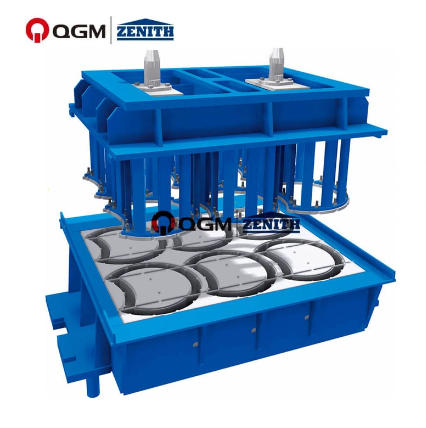
In today’s competitive concrete products market, speed to market and production consistency are no longer optional. Contractors, precast yards, and block producers across North America and Europe are demanding shorter lead times, higher output rates, and tighter dimensional tolerances. Rapid tooling has therefore become a practical solution in Block Machine Mould manufacturing, enabling manufacturers to move from design validation to mass production with far greater agility.
Traditional tooling cycles for a Block Machine Mould could take weeks of machining, fitting, and trial runs before stable output was achieved. With rapid tooling technologies such as CNC high-speed machining, modular insert systems, and advanced heat treatment processes, our factory is able to shorten development cycles while maintaining the structural integrity required for high-frequency vibration systems used in modern block lines.
At Quangong Machinery Co., Ltd., we have integrated digital design modeling with accelerated prototyping to respond quickly to evolving block specifications, whether for hollow blocks, pavers, or kerbstones. This approach ensures our clients can adapt to new municipal standards and building code requirements without production downtime.
Why Do Precision and Tolerance Control Matter More Than Ever?
Concrete block production in developed markets relies heavily on automated batching systems, servo-controlled vibration tables, and pallet circulation lines. In such environments, dimensional deviation of even 0.5 mm can lead to pallet jamming, surface defects, or uneven curing. Rapid tooling improves tolerance control by allowing iterative adjustments during early-stage mold validation.
Our engineering team uses finite element analysis to simulate vibration load distribution before final machining. This ensures the Block Machine Mould cavity walls maintain rigidity under high compaction pressure. Instead of waiting for multiple field corrections, our factory completes precision optimization in-house, reducing installation adjustments at the client site.
Below is a typical technical specification range offered in our standard and heavy-duty mold configurations.
| Parameter | Standard Range | Heavy-Duty Range |
| Steel Grade | High-strength alloy steel 16MnCr5 | Wear-resistant alloy steel with surface hardening |
| Surface Hardness | HRC 58–62 | HRC 60–64 |
| Tolerance Accuracy | ±0.5 mm | ±0.3 mm |
| Heat Treatment Method | Carburizing and quenching | Vacuum heat treatment and nitriding |
| Service Life Estimate | 100,000–150,000 cycles | 150,000–250,000 cycles |
Through rapid tooling strategies, our mold cavity inserts can be adjusted without rebuilding the entire structure. This is particularly valuable for custom block profiles used in infrastructure projects.
How Does Rapid Tooling Reduce Total Cost of Ownership?
In many concrete production facilities, downtime costs far exceed the initial mold purchase price. Rapid tooling reduces lifecycle cost in several ways. First, shorter development cycles mean faster commissioning of new product lines. Second, modular components allow quick replacement of wear parts instead of replacing the complete Block Machine Mould assembly.
Our factory designs interchangeable liners and replaceable core bars, which can be swapped during scheduled maintenance windows. This minimizes unplanned shutdowns and stabilizes daily output targets. Zenith also supports predictive wear analysis based on production data, enabling clients to plan maintenance before dimensional drift affects block geometry.
In markets such as the United States and Western Europe, contractors expect consistent compressive strength ratings and clean edge finishes. Rapid tooling enables fine-tuning of cavity geometry to optimize concrete flow, vibration response, and demolding performance.
What Role Do Advanced Materials and Surface Treatments Play?
High-frequency vibration and abrasive aggregates create extreme wear conditions. Rapid tooling is not limited to speed; it also enhances material selection and surface engineering. Our engineers evaluate aggregate composition, cement ratio, and curing method before recommending surface treatments for the Block Machine Mould.
Common enhancements include nitriding, hard chrome plating, and laser cladding. These processes improve wear resistance and reduce concrete adhesion, which is critical for maintaining smooth demolding cycles in fully automated block plants.
| Surface Treatment | Application Scenario | Performance Benefit |
| Nitriding | High-volume hollow block production | Improved surface hardness and fatigue resistance |
| Hard Chrome Plating | Paver and interlocking brick lines | Reduced friction and easier release |
| Laser Cladding | Abrasive aggregate environments | Extended wear life and impact resistance |
By combining rapid tooling methods with optimized metallurgy, our factory ensures that each Block Machine Mould maintains structural stability even under continuous three-shift operation.
Why Is Customization Becoming a Competitive Advantage?
Urban infrastructure projects increasingly require non-standard block dimensions, drainage channels, or decorative finishes. Rapid tooling allows fast adaptation to project-based specifications without disrupting existing production schedules. Our design team works closely with contractors and equipment integrators to align mold structure with vibration table dynamics and pallet size.
Quangong Machinery Co., Ltd. supports both OEM integration and independent retrofitting for major block machine brands. Our ability to deliver customized Block Machine Mould solutions within compressed lead times gives producers a measurable edge in bidding for municipal and commercial projects.
Frequently Asked Questions
Q: Why Is Rapid Tooling Becoming Essential for Block Machine Mould Manufacturing?
A: Rapid tooling shortens development cycles, improves dimensional accuracy, and reduces downtime risks. In high-output concrete plants, even minor deviations can interrupt pallet circulation and affect block quality. Accelerated prototyping and modular inserts allow faster validation, precise adjustments, and long-term cost control.
Q: Does rapid tooling compromise mold durability compared to traditional methods?
A: No. When properly engineered, rapid tooling integrates high-strength alloy steel, advanced heat treatment, and surface hardening technologies. The structural integrity and service life meet or exceed traditional molds because digital simulation and precision machining eliminate many early-stage defects.
Q: How can manufacturers evaluate whether rapid tooling is suitable for their production line?
A: Evaluation should consider annual production volume, block variety, tolerance requirements, and maintenance capability. Plants running automated, high-speed lines benefit most from rapid tooling due to the need for precise alignment and minimal downtime. A technical assessment of vibration force and pallet system compatibility is recommended.
Rapid tooling is no longer a temporary trend; it has become a structural shift in modern mold engineering. By integrating advanced materials, modular architecture, and precision machining, manufacturers can achieve faster deployment, longer service life, and higher production stability. At Quangong Machinery Co., Ltd., our commitment to engineering excellence ensures that our factory delivers reliable solutions tailored to demanding concrete production environments. Contact our technical team today to discuss how our customized solutions can enhance your production efficiency and secure long-term operational performance.
