

Why Reverse Osmosis Equipment Is Critical for Boiler Feed Water in Power Plants?
2026-09-29
A 300 MW coal-fired power plant consumes approximately 1,200 tons of boiler feed water per hour. If that water contains 500 milligrams per liter of dissolved solids, the plant is introducing 600 kilograms of salt into the boiler every hour. Over a year of operation, that is over 5,000 tons of potential scale-forming material. Softening removes hardness but leaves sodium, chloride, sulfate, and silica in the water. These dissolved solids concentrate in the boiler as steam is generated. When they exceed their solubility limits, they precipitate as scale on the heat transfer surfaces. A 1 mm layer of scale increases fuel consumption by 2 to 4 percent and can lead to tube overheating and failure. Reverse Osmosis Equipment removes 95 to 99 percent of these dissolved solids before the water enters the demineralizer or the boiler. This guide explains why RO is the first line of defense in power plant water chemistry.
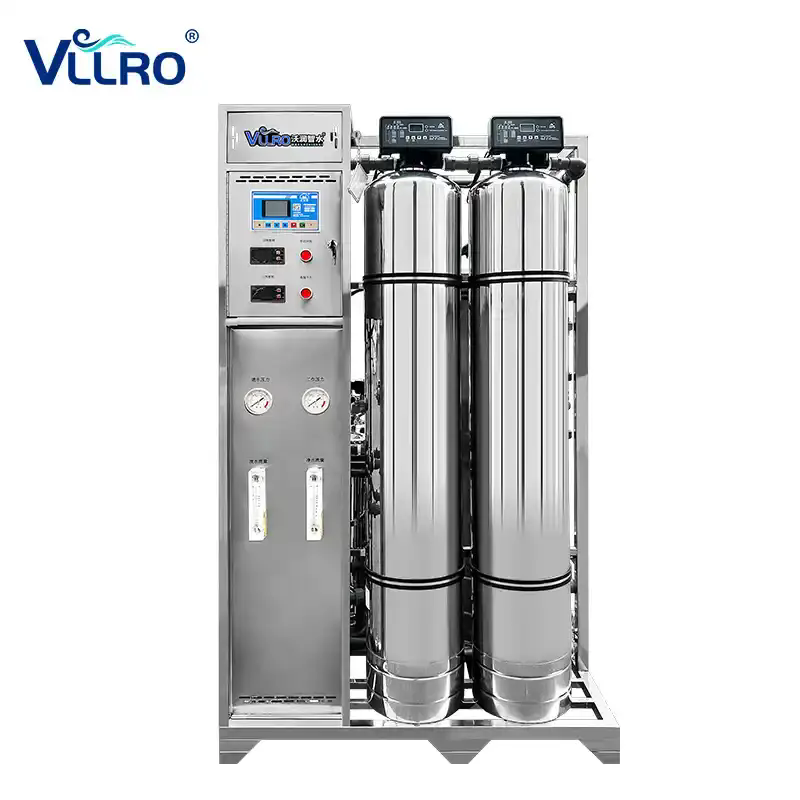
1. What Happens to a Boiler When Dissolved Solids Are Not Removed?
Dissolved solids in boiler feed water cause three problems. The first is scale formation. Calcium, magnesium, and silica precipitate on the boiler tubes when their concentration exceeds the solubility limit. The scale acts as an insulator, which reduces heat transfer and increases the tube metal temperature. The second is corrosion. Chlorides and sulfates concentrate in the boiler water and attack the protective magnetite layer on the tube surface. This leads to under-deposit corrosion and pitting. The third is carryover. High dissolved solids increase the foaming tendency of the boiler water, which causes liquid droplets to be carried over with the steam. These droplets contain salts that deposit on the superheater and turbine blades. The table below shows the recommended limits for boiler water chemistry at different pressure ranges.
| Boiler pressure range | Total dissolved solids limit | Silica limit | Chloride limit |
| 0 – 20 bar | 3,500 ppm | 150 ppm | 500 ppm |
| 20 – 40 bar | 2,000 ppm | 90 ppm | 300 ppm |
| 40 – 60 bar | 1,000 ppm | 40 ppm | 150 ppm |
| 60 – 100 bar | 200 ppm | 10 ppm | 50 ppm |
| 100 – 150 bar | 50 ppm | 2 ppm | 10 ppm |
At 100 bar, the dissolved solids limit is only 50 ppm. If the feed water contains 500 ppm, the boiler must blow down 10 percent of its water to maintain the limit. That blowdown represents a significant energy and water loss. In our factory, we design Reverse Osmosis Equipment that reduces the feed water dissolved solids to below 50 ppm, which minimizes blowdown and maximizes cycle efficiency.
2. How Does Reverse Osmosis Equipment Remove Dissolved Solids?
Reverse Osmosis Equipment uses a semi-permeable membrane to separate water from dissolved solids. The feed water is pressurized to 15 to 70 bar, depending on the salinity, and forced through the membrane. The membrane rejects 95 to 99 percent of the dissolved ions, including sodium, chloride, sulfate, calcium, and magnesium. The rejected ions are concentrated in the reject stream, which is discharged. The permeate, which contains less than 5 percent of the original dissolved solids, is sent to the demineralizer or the boiler. The table below shows the typical rejection rates for different ions.
| Ion | Typical rejection rate | Feed concentration (ppm) | Permeate concentration (ppm) |
| Sodium | 95 – 98% | 200 | 4 – 10 |
| Chloride | 96 – 99% | 150 | 1.5 – 6 |
| Sulfate | 98 – 99.5% | 100 | 0.5 – 2 |
| Calcium | 97 – 99% | 80 | 0.8 – 2.4 |
| Silica | 85 – 95% | 30 | 1.5 – 4.5 |
The rejection rate depends on the membrane type, the feed water chemistry, and the operating pressure. In our factory, we use polyamide thin-film composite membranes that are specifically designed for high-rejection and low-fouling operation. We also offer a two-pass RO system for power plants that require permeate with less than 1 ppm of dissolved solids.
3. What Are the Pre-Treatment Requirements for RO in a Power Plant?
Reverse Osmosis Equipment is not a stand-alone solution. It requires proper pre-treatment to protect the membranes and maintain performance. The pre-treatment typically includes clarification, media filtration, activated carbon, and antiscalant dosing. The table below shows the typical pre-treatment train for a power plant RO system.
| Pre-treatment step | Purpose | Target effluent quality |
| Clarification | Remove suspended solids and turbidity | < 5 NTU |
| Media filtration | Remove fine particles and silt | SDI < 5 |
| Activated carbon | Remove chlorine and organics | Chlorine < 0.1 ppm |
| Antiscalant dosing | Prevent calcium carbonate and sulfate scaling | Langelier Saturation Index < 0 |
| Cartridge filtration | Protect membranes from particles | 5 micron absolute |
The Silt Density Index is the most critical parameter for RO pre-treatment. If the SDI is above 5, the membranes will foul rapidly, and the cleaning frequency will increase. In our factory, we provide a complete pre-treatment design package with every Reverse Osmosis Equipment system. We also offer a pilot testing service to verify the pre-treatment performance with the actual feed water.
4. How Does RO Reduce Blowdown and Improve Cycle Efficiency?
The blowdown rate is determined by the dissolved solids concentration in the boiler water and the feed water. If the feed water contains 500 ppm of dissolved solids and the boiler limit is 50 ppm, the blowdown rate must be 10 percent. If the feed water is treated with RO and the dissolved solids are reduced to 25 ppm, the blowdown rate can be reduced to 2 percent. This reduction in blowdown saves water, chemicals, and energy. The table below shows the impact of RO on blowdown and operating cost for a 300 MW plant.
| Parameter | Without RO | With RO |
| Feed water dissolved solids | 500 ppm | 25 ppm |
| Boiler water limit | 50 ppm | 50 ppm |
| Blowdown rate | 10% | 2% |
| Blowdown flow (tons/hour) | 120 | 24 |
| Annual water saving (tons) | N/A | 768,000 |
| Annual fuel saving (tons of coal) | N/A | 2,500 |
Economic impact: For a 300 MW plant, reducing the blowdown rate from 10 percent to 2 percent saves approximately 768,000 tons of water per year and 2,500 tons of coal per year. The Reverse Osmosis Equipment investment is typically recovered within 18 to 24 months.
Frequently Asked Questions About Reverse Osmosis Equipment for Boiler Feed Water
Summary for Power Plant Water Treatment Engineers
Reverse Osmosis Equipment is critical for boiler feed water in power plants because it removes 95 to 99 percent of dissolved solids before they enter the boiler. This reduces scale formation, corrosion, and carryover. It also reduces the blowdown rate, which saves water, chemicals, and fuel. The pre-treatment design is essential to protect the membranes and maintain performance. For power plants that require the highest water quality, RO is combined with demineralization. Jianyun Zhishui (Qingdao) Industrial Technology Co., Ltd. has been designing and manufacturing Reverse Osmosis Equipment for power plants for over 15 years.
Jianyun Zhishui (Qingdao) Industrial Technology Co., Ltd. manufactures Reverse Osmosis Equipment for boiler feed water treatment in power plants. We provide pre-treatment design, pilot testing, and full system commissioning.
